Cal-Hypo vs Dichlor Shock: Pick by What Each Adds
Neither is "better" — I pick by what each one smuggles in. Cal-hypo adds calcium (bad news if your CH is already 400+); dichlor adds CYA, about 9 ppm per 10 ppm of FC (bad news if CYA is already high). If both numbers are fine, either works. If either is high, I reach for liquid chlorine instead — it adds nothing but chlorine.
Walk into any pool store and shock choice looks like brand preference. It is not — it is chemistry preference. Every granular shock smuggles a second chemical into your water, and the right pick depends on which second chemical your water can tolerate. Once you see it that way, the choice makes itself.
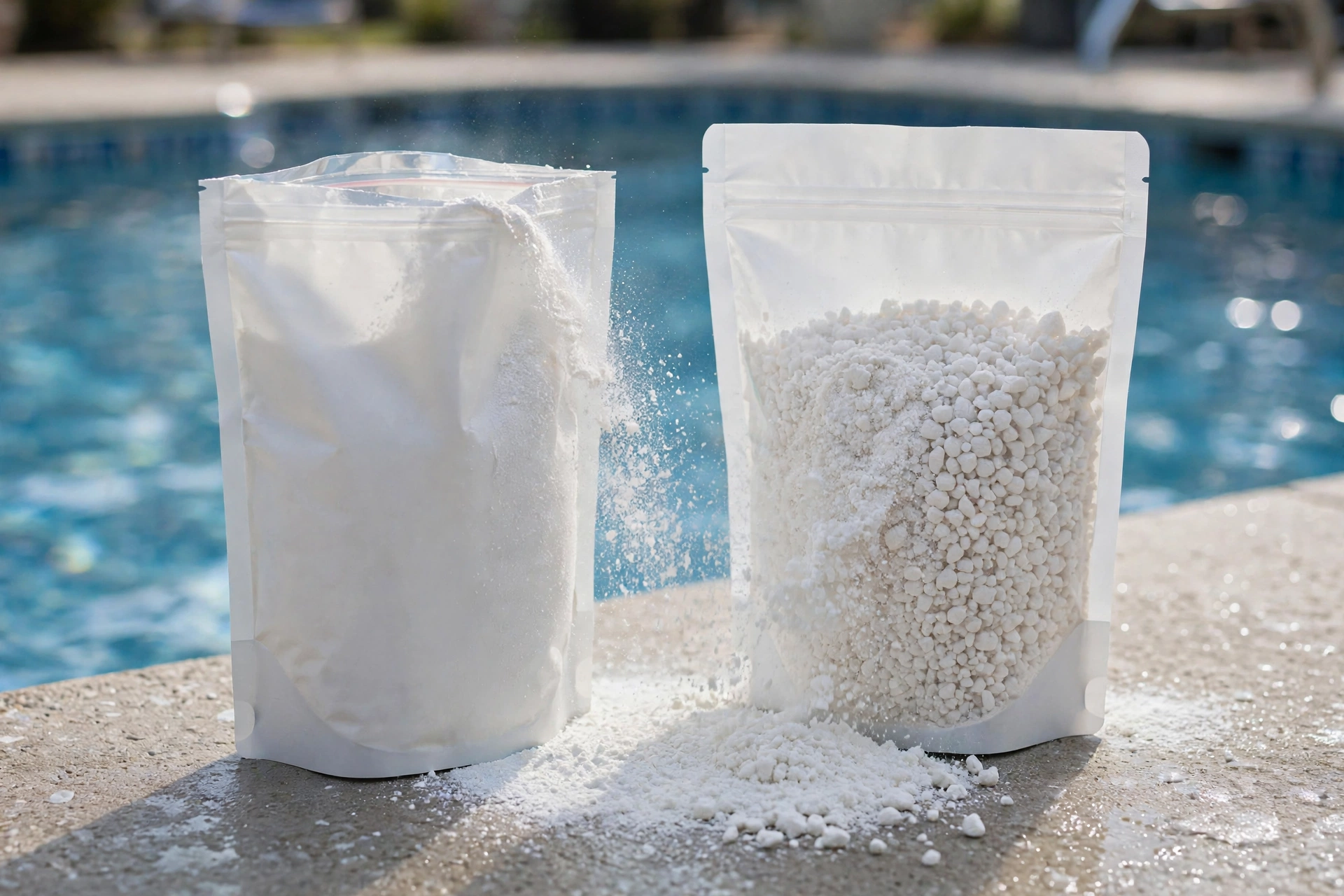
Cal-hypo: calcium hypochlorite
Roughly 65% available chlorine, plus calcium. Every dose nudges calcium hardness up. That is great when CH is low — vinyl pools often run low — and it is a trap when CH is already high: the classic result is a pool that turns milky right after shocking, because the fresh calcium precipitates out. If that is your story, cloudy after shock explains the whole thing.
Practical note, and do not skip it: cal-hypo does not fully dissolve. Pre-dissolve it in a bucket, pour the liquid in, and leave the undissolved granules behind — otherwise they settle and bleach spots into liners. Your product label’s dissolving instructions are the final word here.
Dichlor: sodium dichloro-s-triazinetrione
About 55–60% available chlorine plus CYA — roughly 9 ppm CYA for every 10 ppm of FC delivered. It dissolves fast and completely, and its pH is nearly neutral, which is why people love it. But in a long shock process like a SLAM, that CYA accumulates shockingly fast — pun intended — and can push you into overstabilization mid-treatment. Fixing an algae bloom while creating a CYA problem is a special kind of frustration.
So: dichlor is a fine occasional shock for a low-CYA pool. It is a terrible daily sanitizer, for exactly the same reason tablets are.
The third option: liquid chlorine
Then there is the third option, and it is my default: liquid chlorine at 10–12.5%. It adds nothing but chlorine and a touch of salt — no calcium, no CYA. For SLAMs, and for any pool already high in either number, it is the right answer. The only downside is hauling jugs, and I will take sore arms over a chemistry mess.
Decision rule
The decision rule I actually use: CH low and CYA fine → cal-hypo is fine. CYA low and CH fine → dichlor is fine. Either one high → liquid chlorine. Both high → liquid chlorine, and a partial drain is in your future whether you like it or not. When in doubt, liquid chlorine is never the wrong shock.