Pool Won’t Hold Chlorine? The Real Reasons (and Fixes)
If your chlorine won't hold, something is consuming it faster than you add it — and it's almost always one of five things: early-stage algae you can't see yet, CYA so high the chlorine can't work, CYA at zero so sunlight burns it off, ammonia or organics after winter, or a test that's lying to you. Test CYA first, then run the overnight chlorine test. The fix depends entirely on those two numbers — 'add more shock' without them is just guessing.
Here's the post I see every single week on pool forums, in some version: two jugs of liquid chlorine went in at 8pm, the test read zero at 7am, and the pool looks perfectly clear. The owner is baffled. Sometimes angry. Usually about to buy a third jug.
And here's what makes this problem so maddening: every cause feels identical. Whether it's algae, bad CYA, sunlight, or ammonia, the symptom is the same — chlorine goes in, nothing shows up. That's why random advice fails here. 'Shock it harder' is the right answer for exactly one of the five causes, and an expensive waste on the other four.
So let's diagnose like a mechanic instead of guessing like a gambler. Two tests, one table, and you'll know exactly what's eating your chlorine. Then — and only then — you decide what to buy.
- Step 1: Run the two tests that matter — in this order
- The diagnostic table: match your readings to the cause
- The overnight test: proof of what's alive in your water
- Your CYA sets your chlorine target — here's the math
- How a summer of tablets builds this problem quietly
- The winter surprise: ammonia (uncommon, but real)
- Before you buy anything: the five-minute checklist
Pool chemical dose calculator
Estimate from standard pool-industry dosing ratios. Add two-thirds, retest after circulation, then top up. Never mix chlorine products together. Your product label has the final say.
Step 1: Run the two tests that matter — in this order
Test CYA first. I know that feels backwards — your problem is chlorine, not stabilizer — but CYA decides what every other number means. A free chlorine reading of 3 ppm is perfectly fine at CYA 40 and nearly useless at CYA 120. Without the CYA number, your FC reading is a guess wearing a lab coat.
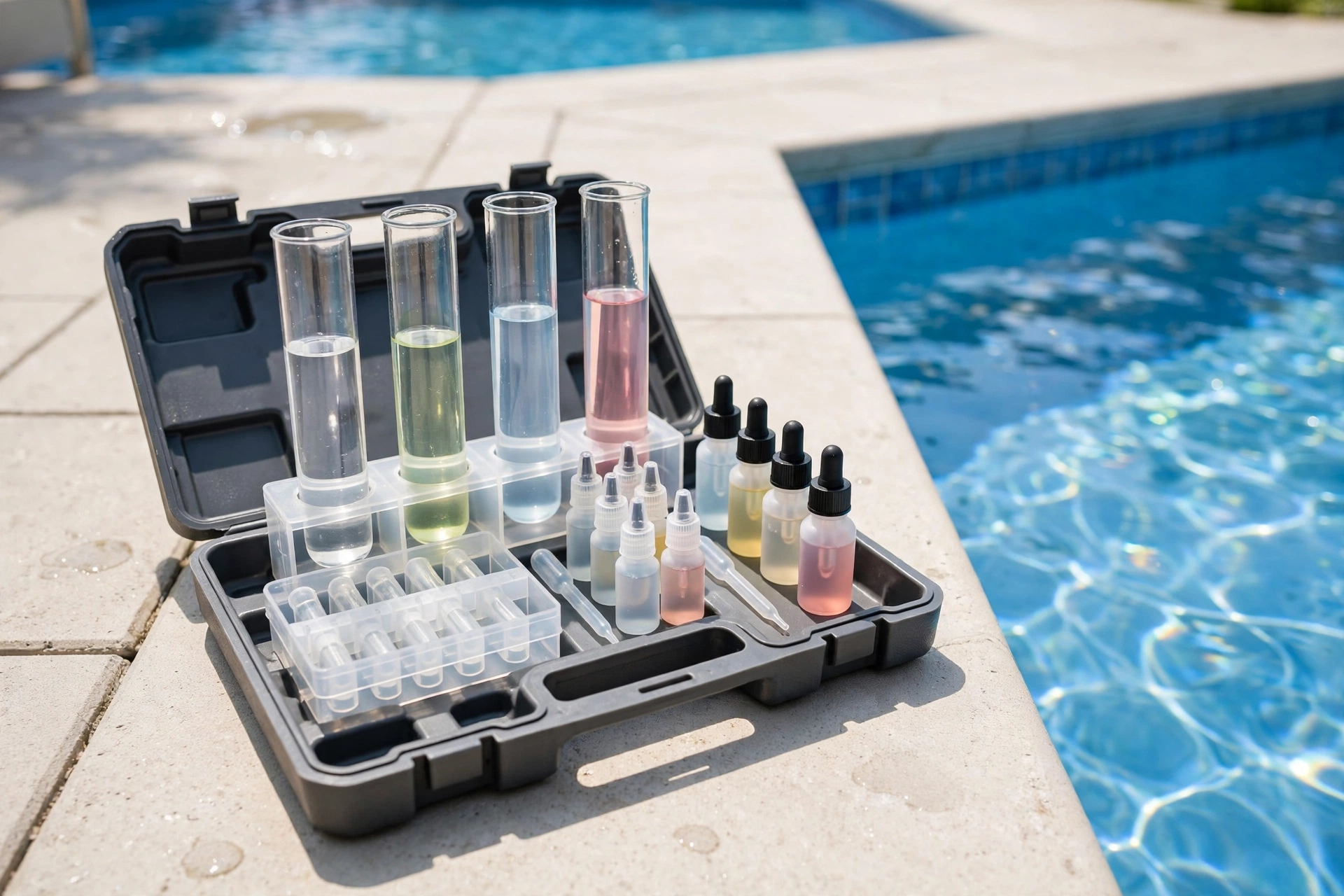
Then test free chlorine with a FAS-DPD drop test, not strips. Strips aren't precise enough for this diagnosis, and at very high chlorine levels they can bleach out and read zero when chlorine is actually sky-high — yes, your test can lie to you, and there's a whole row in the table below for that. Write both numbers down.
Now find your row in the diagnostic table. That row is your diagnosis. The rest of this page just makes sure you believe it enough to act on it.
The diagnostic table: match your readings to the cause
Find the row that looks like your pool. Be honest about which one it is — most people want their row to be the easy one, and that's exactly how the wrong fix gets bought.
If your row is the first one, the overnight test in the next section is your proof. If it's the second, jump to the CYA math section. The table is the whole shortcut.
| What your tests show | Most likely cause | What actually fixes it |
|---|---|---|
| FC drops to zero overnight; CYA 30–50 | Early-stage algae or organics | A full [[slam-method-pool|SLAM]] — one shock won't finish it |
| FC reads normal but problems persist; CYA 90+ | Overstabilization — chlorine present but handcuffed | Partial drain to 30–50 CYA; stop using stabilized products |
| FC vanishes during the day; CYA near zero | No stabilizer — sunlight destroying it | Add stabilizer to 30–50 ppm ([[pool-stabilizer-calculator|stabilizer calculator]]) |
| Huge demand after opening; CYA mysteriously low | Ammonia or organics from winter (uncommon) | Steady liquid chlorine until FC holds, then [[slam-method-pool|SLAM]] if needed |
| FC reads zero right after adding a lot | Test error — bleached reading at very high FC | Re-test with FAS-DPD drops before doing anything drastic |
| FC drops 1–3 ppm daily; CYA normal | Normal use — sun plus bathers | Evening dosing to your CYA-based target |
The overnight test: proof of what's alive in your water
This is the single most useful test in pool ownership and it costs one evening. After sunset — with no sun left to blame — raise your free chlorine to a clearly measurable level, around 5 ppm. Write the number down. Go to bed. Before sunrise, before light touches the pool, test again. Add nothing in between.
Lost more than 1 ppm overnight? That chlorine went somewhere, and in the dark the only thing that consumes chlorine is living or decaying organic matter — usually early-stage algae you can't see yet. That's not a guess. That's a definitive answer, the kind no forum thread can give you.
What the test can't tell you: it can't distinguish algae from other organics, and it says nothing about your CYA — that's why CYA comes first. But as a yes-or-no on 'is something alive in my water,' it's the best tool you own.
And if the answer is yes, the fix is a full SLAM — not another single shock. A single shock is a punch; SLAM is holding shock level until the job is done. The finish line has three parts: water clear, combined chlorine at or under 0.5 ppm, and overnight loss at or under 1 ppm. All three. That's the only ending that sticks.
Evening, after sunset: raise FC to ~5 ppm, record it
Morning, before sunrise: test again, nothing added overnight
Loss of 1 ppm or less: no organics problem — look at CYA
Loss over 1 ppm: something's alive — start SLAM
Your CYA sets your chlorine target — here's the math
Here's the relationship that explains most 'chlorine won't hold' complaints: your minimum effective free chlorine is about 7.5% of your CYA, and shock level is about 40% of it. These aren't exact to the decimal — they're the working rules the whole industry uses — but they change everything about how you read your test.
Run your own numbers through them. At CYA 30, your minimum is about 2 ppm and shock level about 12. At CYA 50, it's 4 and 20. At CYA 100, the minimum is 7.5 — which means the 'normal' 3 ppm dose you've been adding is less than half of what your water actually needs. The chlorine is in there. It just can't do the job.
This is why the symptom feels so strange: the test shows chlorine, the pool misbehaves anyway, and adding more barely moves the needle. You're not under-dosing in absolute terms — you're under-dosing relative to your CYA. Different problem, different fix. The shock calculator shows how the target moves with CYA — punch in your number and watch it change.
| Your CYA | Minimum FC | Shock level |
|---|---|---|
| 30 ppm | ~2 ppm | ~12 ppm |
| 50 ppm | ~4 ppm | ~20 ppm |
| 80 ppm | ~6 ppm | ~32 ppm |
| 100 ppm | ~7.5–8 ppm | ~40 ppm |
How a summer of tablets builds this problem quietly
Nobody wakes up with CYA at 150. It climbs one tablet at a time, and that's what makes it so sneaky. Trichlor tablets add roughly 6 ppm of CYA for every 10 ppm of chlorine they deliver; dichlor shock adds about 9. The chlorine gets consumed doing its job. The CYA accumulates, silently, all season.
Then one week the chlorine 'stops working.' It didn't stop — it got handcuffed gradually, and you crossed the line where normal doses can't sanitize anymore. Every pool forum has a dozen threads a week with this exact plot, and the CYA is always 150-plus and always a surprise.
The way out is water replacement sized to your number — drain a percentage, CYA drops by about the same percentage — and then switching daily chlorination to something that doesn't add CYA, usually liquid chlorine. The full comparison at tablets vs liquid chlorine is worth the read before next season starts.
The winter surprise: ammonia (uncommon, but real)
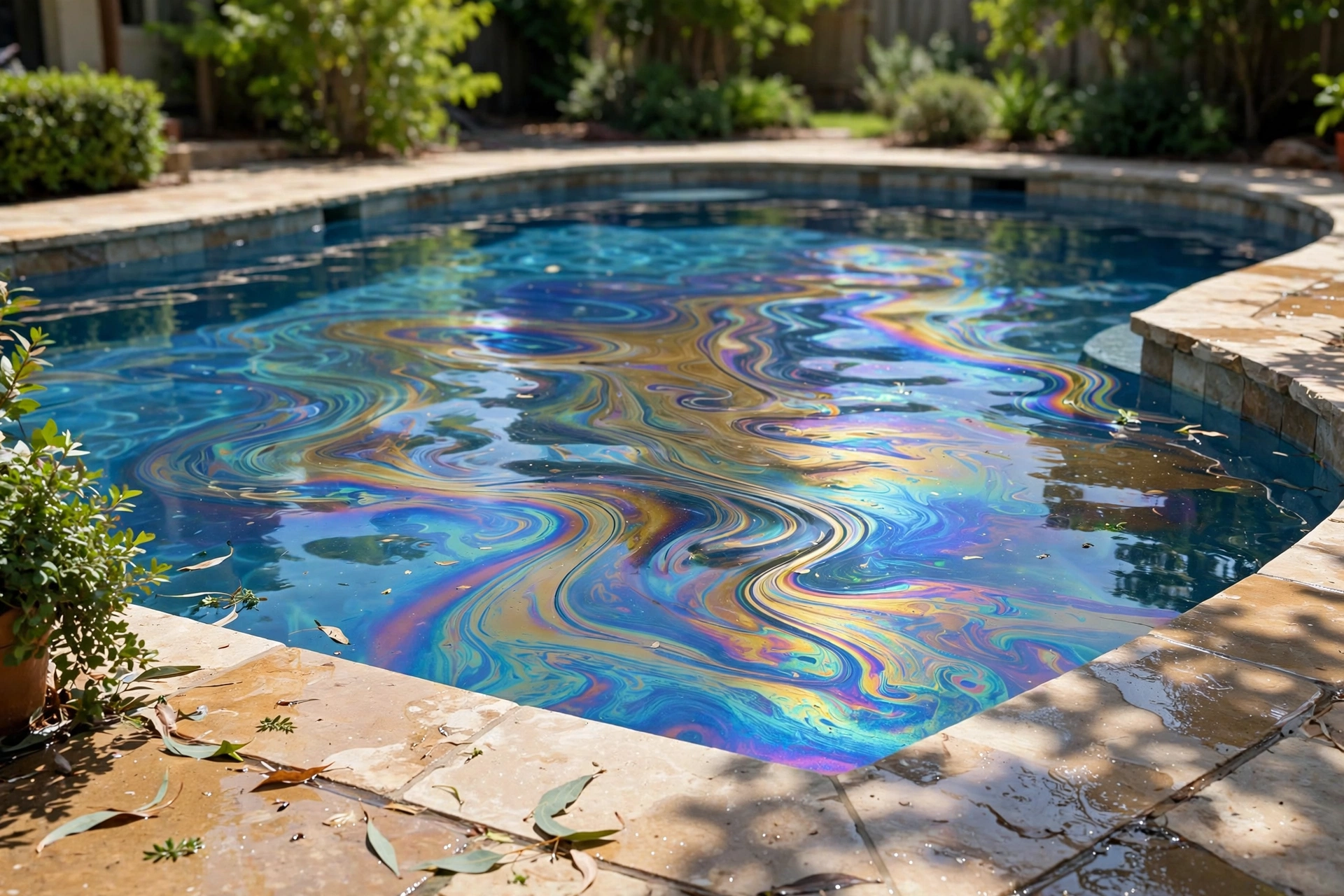
One more cause, and I'll be upfront that it's the rare one — but when it hits, it mimics everything else, so it earns a section. Over winter, bacteria can convert CYA into ammonia. Come spring, your CYA reads mysteriously lower than it did in fall, and chlorine demand is enormous: the first several doses vanish with almost no FC reading to show for it.
The tell is the combination: the pool was closed all winter, CYA dropped on its own, and chlorine seems to pour into a black hole. The fix is unglamorous — keep adding liquid chlorine steadily, not all at once, until FC starts to hold. You're burning through the ammonia backlog. Once FC holds, run a normal SLAM if the water needs it. This one resolves with chlorine and patience, not with draining.
Before you buy anything: the five-minute checklist
Run through this list in order. Most people find their answer by item three.
Test CYA first — every fix on this page depends on that number
Test FC with drops, not strips — strips aren't precise enough here
CYA normal but FC vanishing? Run the overnight test before anything else
Check what you've been adding — tablets and dichlor raise CYA with every dose
Dose in the evening — chlorine works overnight instead of fighting midday sun
If the story makes no sense, suspect the test before suspecting the pool
- Overnight FC loss over 1 ppm means something alive is consuming chlorine.
- Minimum effective FC ≈ 7.5% of CYA — at CYA 100, that's 7.5 ppm, not 3.
- Shock level ≈ 40% of CYA — at CYA 50, that's about 20 ppm.
- Trichlor adds ~6 ppm CYA per 10 ppm FC; dichlor adds ~9.
- Without CYA, a sunny afternoon can burn through several ppm of FC.
- SLAM is finished when: water clear, CC ≤ 0.5 ppm, overnight loss ≤ 1 ppm.