Pool Chlorine Calculator: Exact Dose for Your Gallons
Enter your gallons, current free chlorine, and target — the calculator returns the exact dose. The math: one gallon of 12.5% liquid chlorine in 10,000 gallons raises FC by about 12.5 ppm, so roughly 10 fluid ounces raises 10,000 gallons by 1 ppm. Your target depends on CYA: 3–5 ppm is the sweet spot at CYA 30–50.
Almost everyone asks this question wrong. 'How much chlorine do I add?' has no answer by itself — it is like asking 'how much fuel?' without saying how far you are driving. The real question has three parts: how many gallons you have, where your chlorine is now, and where your CYA says it should be. Get those three right and the dose is just arithmetic.
That is what the calculator above does — the arithmetic. This page is everything around it: the product reference table, worked examples so you can sanity-check the math yourself, and the mistakes that make good math give bad results. Do not know your gallons? Run the pool volume calculator first — every dose on this site starts from that number.
Pool chemical dose calculator
Estimate from standard pool-industry dosing ratios. Add two-thirds, retest after circulation, then top up. Never mix chlorine products together. Your product label has the final say.
The three numbers every dose depends on
Gallons first. Not the number on your pool paperwork from 1998 — your actual water volume. A wrong gallon figure corrupts every dose you ever calculate, and 'about 20,000' when it is really 15,000 means you have been overdosing by a third for years. Measure once with the volume calculator and write the number on the equipment pad.
Current free chlorine, from a real test — not a guess, not 'it looks fine.' Strips or drops, either works for dosing purposes. You cannot calculate a gap without knowing where you stand.
On test kits: for dosing purposes, either strips or a drop kit works — but know what you are holding. Strips are fast and fine for routine top-ups; a drop-based kit (the kind with the comparator tube) reads FC more precisely, which matters when you are calculating a shock dose or diagnosing why chlorine will not hold. If your doses keep missing, upgrade the test before blaming the math.
Target FC, which comes from your CYA. At CYA 30–50, most pools live happily at 3–5 ppm. CYA grabs chlorine and holds some in reserve, so the same 3 ppm means different things at different CYA — at CYA 80, 3 ppm is weak chlorine wearing a disguise. Never tested CYA? Read what CYA is before trusting any dose number.
One habit that pays for itself: write all three numbers down every time you dose, with the date. A month of those notes teaches you your pool's appetite — how many ppm it burns on a hot Saturday versus a cool weekday — and that is worth more than any rule of thumb I could give you.
The product reference table
Every chlorine product below does the same job at a different strength. Find yours, read across for the dose that raises 10,000 gallons by 1 ppm, and scale to your pool. These are standard pool-math figures, not guesses.
Comparing prices? Think per ppm, not per gallon — a gallon of 12.5% delivers roughly twice the chlorine of 6% bleach, so the 'cheaper' jug often is not. The full breakdown is at liquid chlorine vs tablets.
| Product | Strength | Dose per 10k gal for +1 ppm | Watch out for |
|---|---|---|---|
| Liquid chlorine | 12.5% | ~10 fl oz | Degrades in heat and light — buy fresh, store cool and dark |
| Liquid chlorine | 10% | ~13 fl oz | Same as above; common at pool stores |
| Plain bleach | 8.25% | ~15.5 fl oz | Must be plain and unscented — no splashless, no scent |
| Plain bleach | 7.5% | ~17 fl oz | Check the label percentage; it varies by brand |
| Plain bleach | 6% | ~21 fl oz (about 2 and two-thirds cups) | Weakest option — fine, just use more |
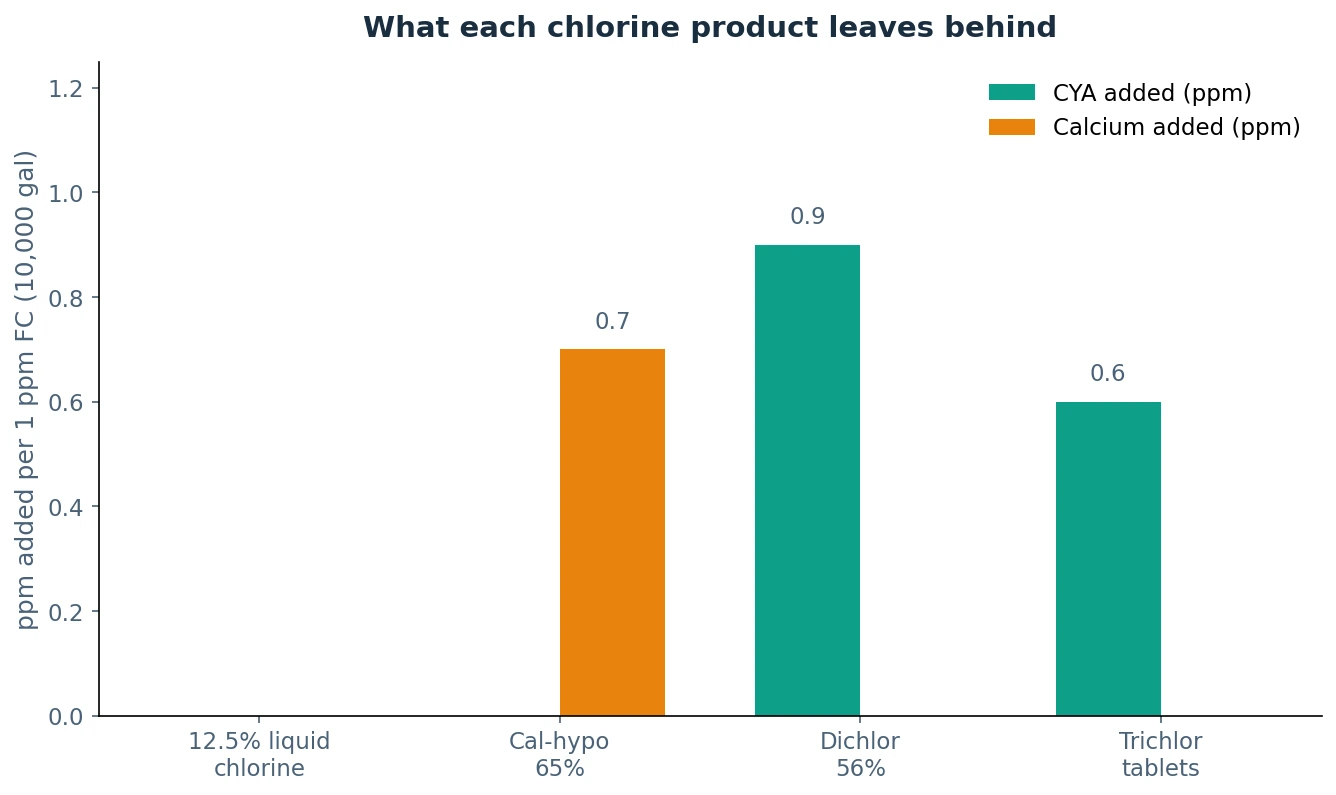
| Cal-hypo granules | 65% | ~2 oz by weight | Adds calcium (roughly 0.7 ppm CH per ppm FC); pre-dissolve, never mix with other chlorine types |
| Dichlor granules | 55–62% | ~2.4 oz by weight | Adds roughly 0.9 ppm CYA per ppm of FC — CYA creep is real |
| Trichlor tablets | ~90% | 1 tablet ≈ +5 ppm FC per 10k gal over several days | Adds roughly 3 ppm CYA per tablet per 10k gal; slow erosion, not a quick dose |
Three worked examples — check the math yourself
Example one, the routine top-up: 15,000 gallons, FC at 2, target 5 — a 3 ppm gap. At 12.5%, that is 3 × 10 fl oz × 1.5 = 45 fl oz, about 1.4 quarts. The calculator says the same; now you know why.
Example two, the small pool: 3,000 gallons, FC at 1, target 4 — a 3 ppm gap. That is 3 × 10 × 0.3 = 9 fl oz of 12.5%. Small pools punish heavy hands — a cup too much in 3,000 gallons swings FC by well over 2 ppm, so measure, do not pour.
Example three, the shock dose: 20,000 gallons, CYA 40, FC at 2, shock level 16 — a 14 ppm gap. That is 14 × 10 × 2 = 280 fl oz, about 2.2 gallons of 12.5%. Notice the shock target came from CYA (40% of 40 ≈ 16), not from a bag label. For the dedicated tool, use the shock calculator.
Example four, the tablet trap — the one that teaches you about CYA creep: 15,000 gallons, starting CYA 40, running two trichlor tablets a week for 8 weeks. That is 16 tablets × roughly 2 ppm CYA each (3 ppm per 10k gallons, scaled to 15k) = about 32 ppm of CYA added. You started at 40 and you are now near 72 — and your old 3 ppm FC target, which was solid at CYA 40, is now weak. Nothing about your chlorine changed; the meaning of the number did. This is why tablet pools must test CYA monthly.
How to add it (the part people skip)
The dose is only half the job. How and when you add it decides how much survives to do any sanitizing.
Buy chlorine like milk, not like canned beans. Liquid chlorine starts degrading the day it is made, faster in heat — a jug that sat in a sunny store lot all summer can test well below its label. Buy from somewhere with turnover, check date codes if the brand prints them, and store jugs cool, dark, and upright. If your calculated doses suddenly stop landing and nothing else changed, the jug is your prime suspect.
Swimming after a routine dose? Give it 30–60 minutes of circulation, test, and swim once FC is back in your normal range. The full timing rules are at how long after shock you can swim.
Dose in the evening. Sunlight burns off unprotected chlorine fast — evening dosing wastes far less to UV.
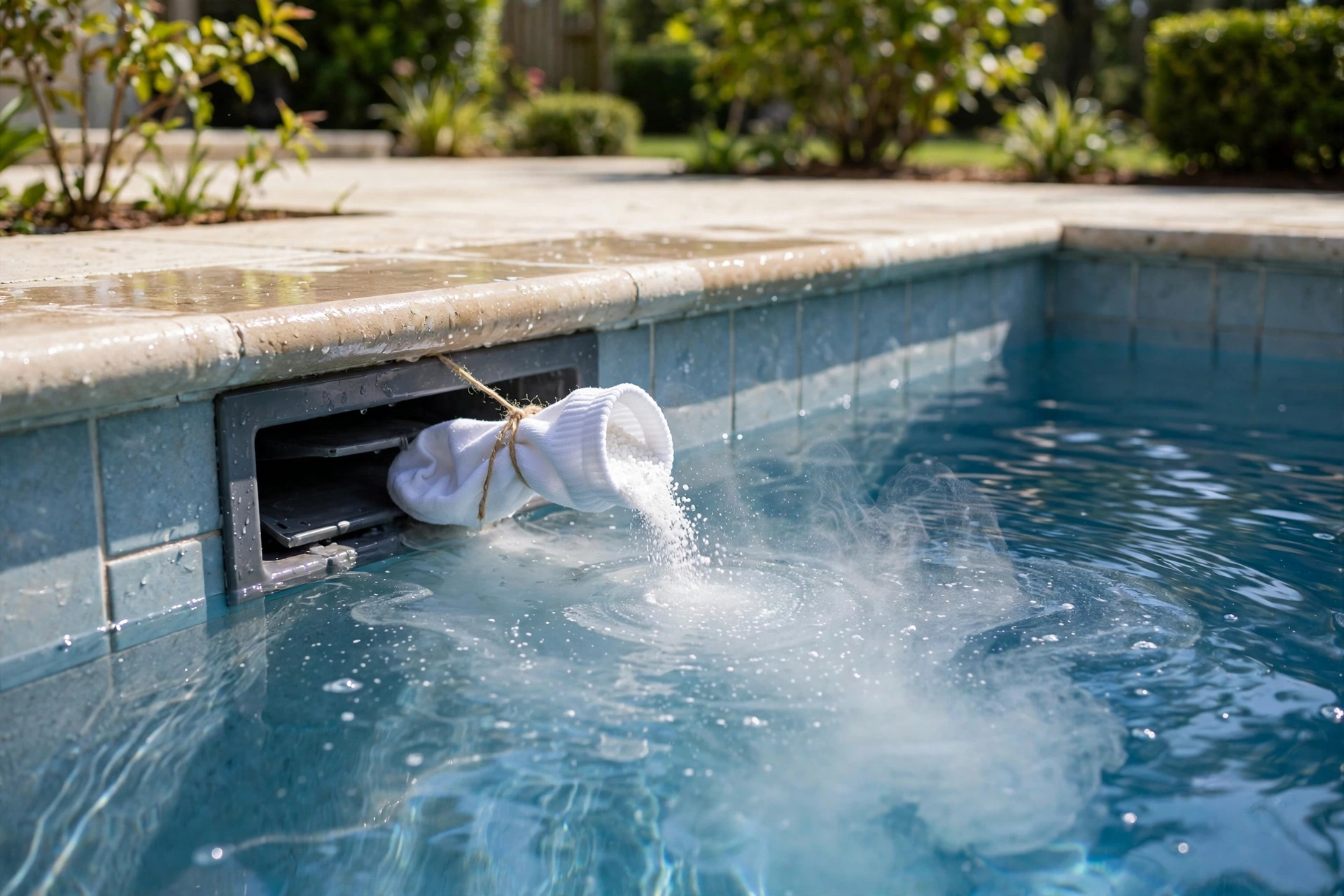
Pour slowly in front of a return jet with the pump running. That disperses it instead of letting it sit in one spot and bleach the liner.
Add two-thirds first, circulate an hour, retest, then top up. Overshooting is worse than undershooting — chlorine drifts down on its own, but too much means you just wait.
Never mix chlorine types together, and never mix chlorine with acid — dry or liquid. Each gets added separately, with circulation between.
Store jugs cool and dark. Heat and sunlight eat chlorine strength while the jug sits there, and a weakened jug is the most common reason 'the math stopped working.'
If your chlorine will not hold at all, stop dosing and fix the consumption problem first. No amount poured into a leak stays poured.
Use a dedicated measuring cup marked in fluid ounces — a plastic jug with ounce marks beats a kitchen cup every time. Guessing 'about a quart' is how 3 ppm becomes 6.
Why the math sometimes 'stops working'
When doses stop matching results, the math is not broken — an input is. The usual suspects, in order: your gallon figure was a guess, your CYA drifted up from tablet use, or your bleach went stale in a hot garage. A jug labeled 7.5% after a summer in the heat is weaker than it claims. Rule out the inputs in this order before you ever blame the product.
The sneakiest one is CYA creep, because it changes the meaning of your target. Each trichlor tablet adds roughly 3 ppm CYA per 10,000 gallons, and it accumulates silently. At CYA 30, 3 ppm FC is solid. Let tablets push CYA to 90 over two seasons without you noticing, and that same 3 ppm is suddenly weak — so you add more chlorine, which does not fix it, because the problem was never the chlorine amount. Test CYA monthly if you use tablets. This is also the story behind the so-called 'chlorine lock'.
And if FC drops to zero within a day no matter what you add, that is not a dosing problem — it is an algae bloom starting, or something consuming chlorine as fast as you add it. The fix is the SLAM method, not a bigger jug.
- 12.5% liquid: ~10 fl oz per 10k gal = +1 ppm FC.
- 6% bleach: ~21 fl oz per 10k gal = +1 ppm FC.
- Target 3–5 ppm FC at CYA 30–50; shock level ≈ 40% of CYA.
- Dose in the evening; add two-thirds, retest, top up.