Green Pool Water: How to Fix It (The SLAM Method, Plainly Explained)
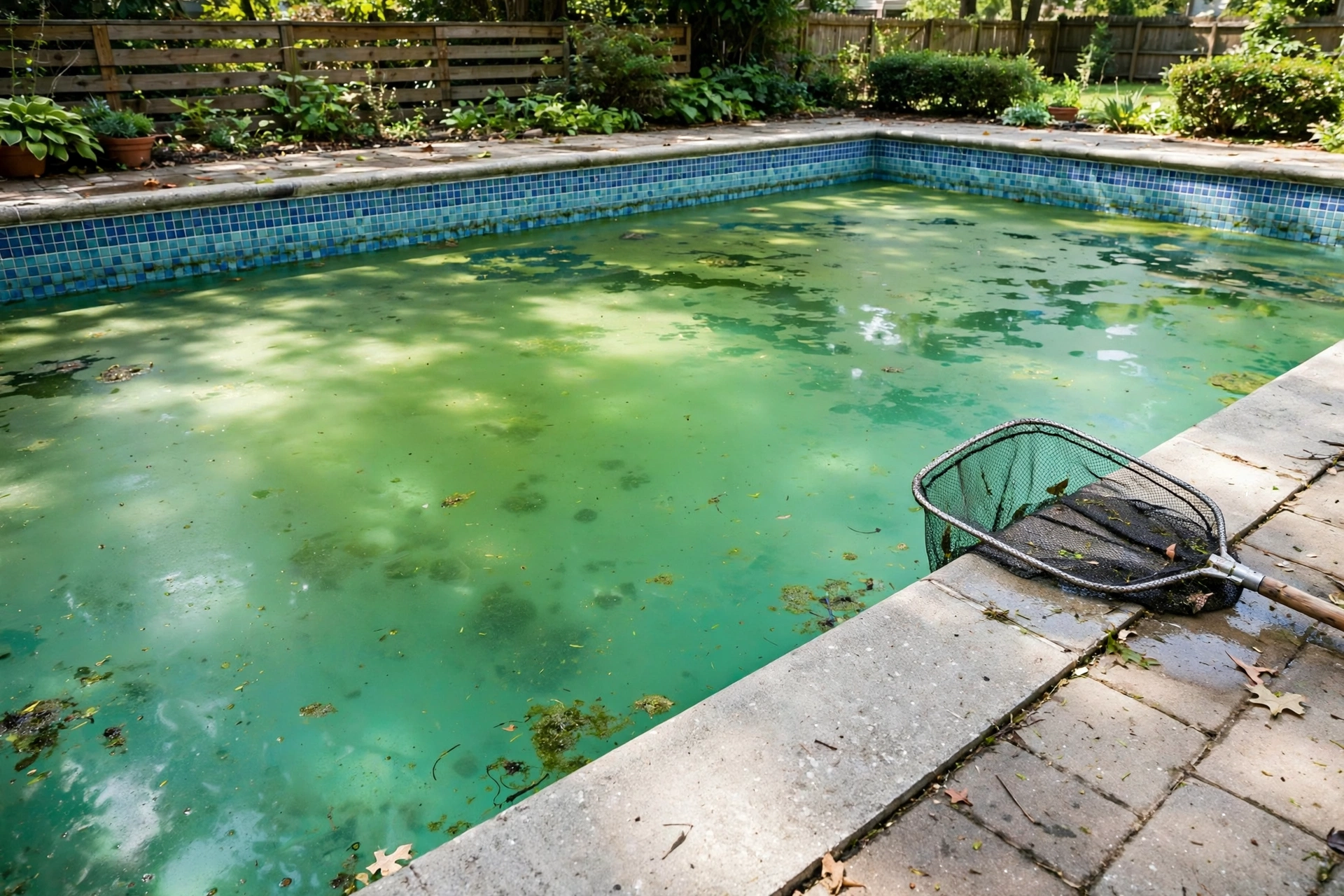
Green water is live algae, and the only fix I've seen work consistently is the SLAM method: raise free chlorine to shock level for your CYA (about 40% of your CYA number), hold it there by testing and topping up 2–3 times a day, brush daily, run the pump 24/7 — and don't stop until three things are all true: the water is clear, overnight chlorine loss is 1 ppm or less, and combined chlorine is 0.5 ppm or less. Expect 3–7 days for a green pool, longer for a swamp.
The shock bag says 'one pound treats 10,000 gallons.' I'll be blunt: for a green pool, that sentence has wasted more money than any other in the pool industry. Not because the arithmetic is wrong — a pound of 65% cal-hypo in 10,000 gallons does raise chlorine roughly 8 ppm — but because a green pool doesn't need a dose. It needs a level, held for days.
That's the entire secret of the SLAM method, and it's the only approach I've watched work over and over in real recoveries: Shock Level And Maintain. You raise chlorine to the level your CYA demands and you keep it there — testing and topping up a few times daily — until three pass conditions are all true. One heroic dump that fades by morning loses to a sustained level every single time. Here's why, and exactly how to do it.
Pool chemical dose calculator
Estimate from standard pool-industry dosing ratios. Add two-thirds, retest after circulation, then top up. Never mix chlorine products together. Your product label has the final say.
Why the one big dump fails: the math of a green pool
A green pool is not a chemistry problem with a single answer — it's a battle of attrition. Every bit of algae in that water is consuming chlorine as fast as you add it, and sunlight burns off whatever the algae doesn't eat. Dump in a big dose at 8 pm and by morning a large share of it is simply gone: eaten by algae, destroyed by UV, or both. The algae that survived the night gets a chlorine-free day to recover.
This is why 'I shocked it three times and it's still green' is such a common story. Three separate blasts, each fading to nothing within hours, never subject the algae to sustained killing pressure. Algae also protects itself with a slimy biofilm — which is why brushing matters so much — and only continuous exposure at a high enough level breaks through it.
The level that breaks through isn't a fixed number, either. Chlorine's killing power is throttled by CYA: the more stabilizer in the water, the more chlorine you need to achieve the same kill rate. That's why the bag's flat dosing rate misleads people. Your required shock level is about 40% of your CYA reading — a pool with CYA 30 needs around 12 ppm, while one with CYA 80 needs around 32 ppm. Same green water, nearly triple the chlorine. Without a CYA number, you're throwing darts blindfolded.
Your CYA sets the dose: the table
Test CYA first with a drop-based kit — strips can't measure it accurately, and this whole method stands on that one number. Find your CYA in the left column: the middle column is your shock-level target, and the right column is roughly how much 12.5% liquid chlorine gets a 10,000-gallon pool from zero to that target. Scale up or down for your gallons, or skip the arithmetic with the shock calculator.
If your CYA is over 90, do a partial drain first. SLAMing at very high CYA demands enormous amounts of chlorine, and dilution is cheaper than chemistry at that point.
| Your CYA (ppm) | Shock-level FC target (ppm) | 12.5% liquid chlorine per 10,000 gal |
|---|---|---|
| 30 | ~12 | ~1 gallon |
| 40 | ~16 | ~1.3 gallons |
| 50 | ~20 | ~1.6 gallons |
| 60 | ~24 | ~1.9 gallons |
| 70 | ~28 | ~2.2 gallons |
| 80 | ~32 | ~2.6 gallons |
The SLAM, day by day
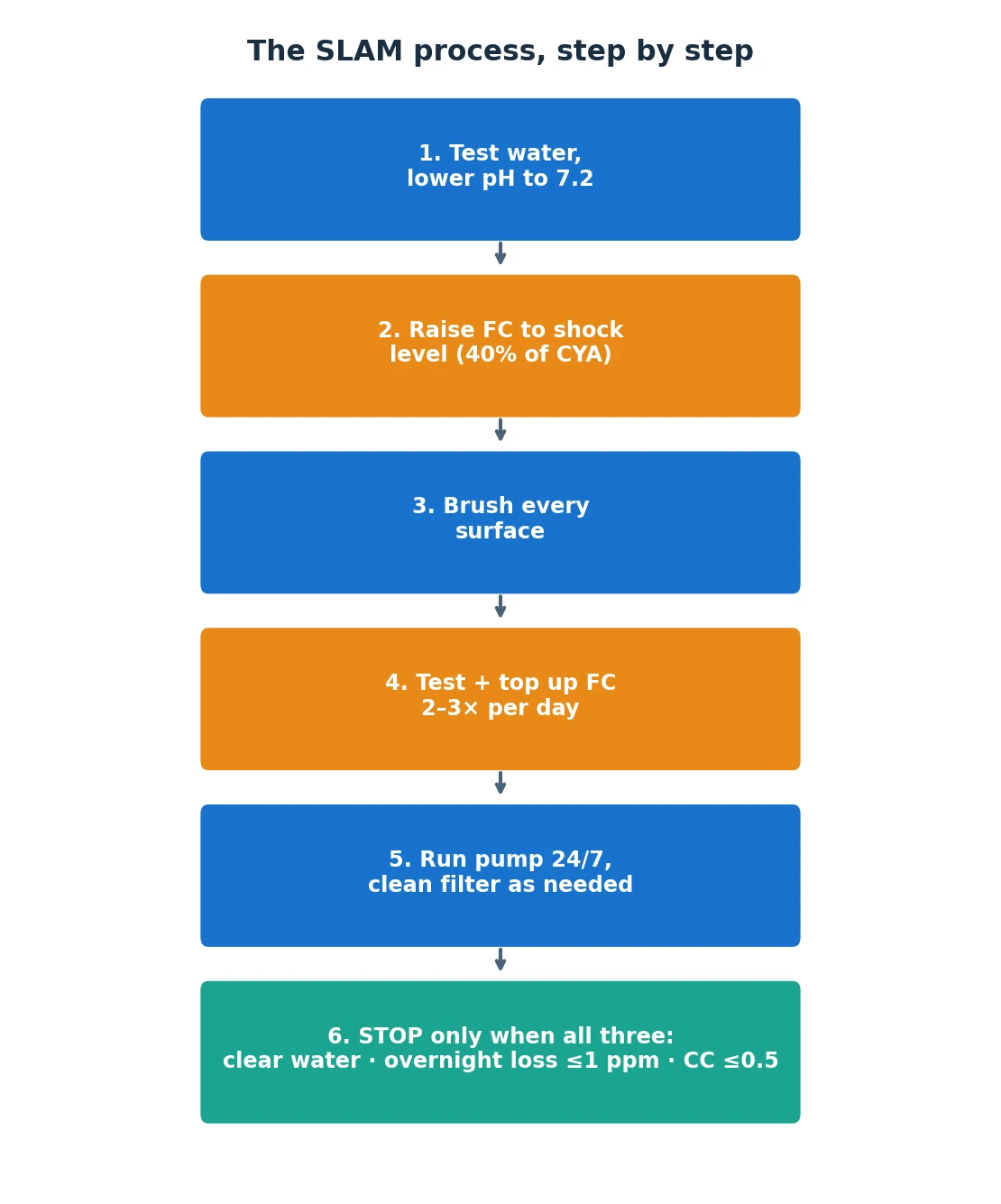
Prep first: lower pH to about 7.2 before you start — chlorine sanitizes better slightly acidic, and you can't trust pH readings at shock-level chlorine anyway, so get it right now while readings are still meaningful. Then add your starting dose from the table above, poured slowly in front of a running return jet. From here, the routine is gloriously boring — and boring is what works.
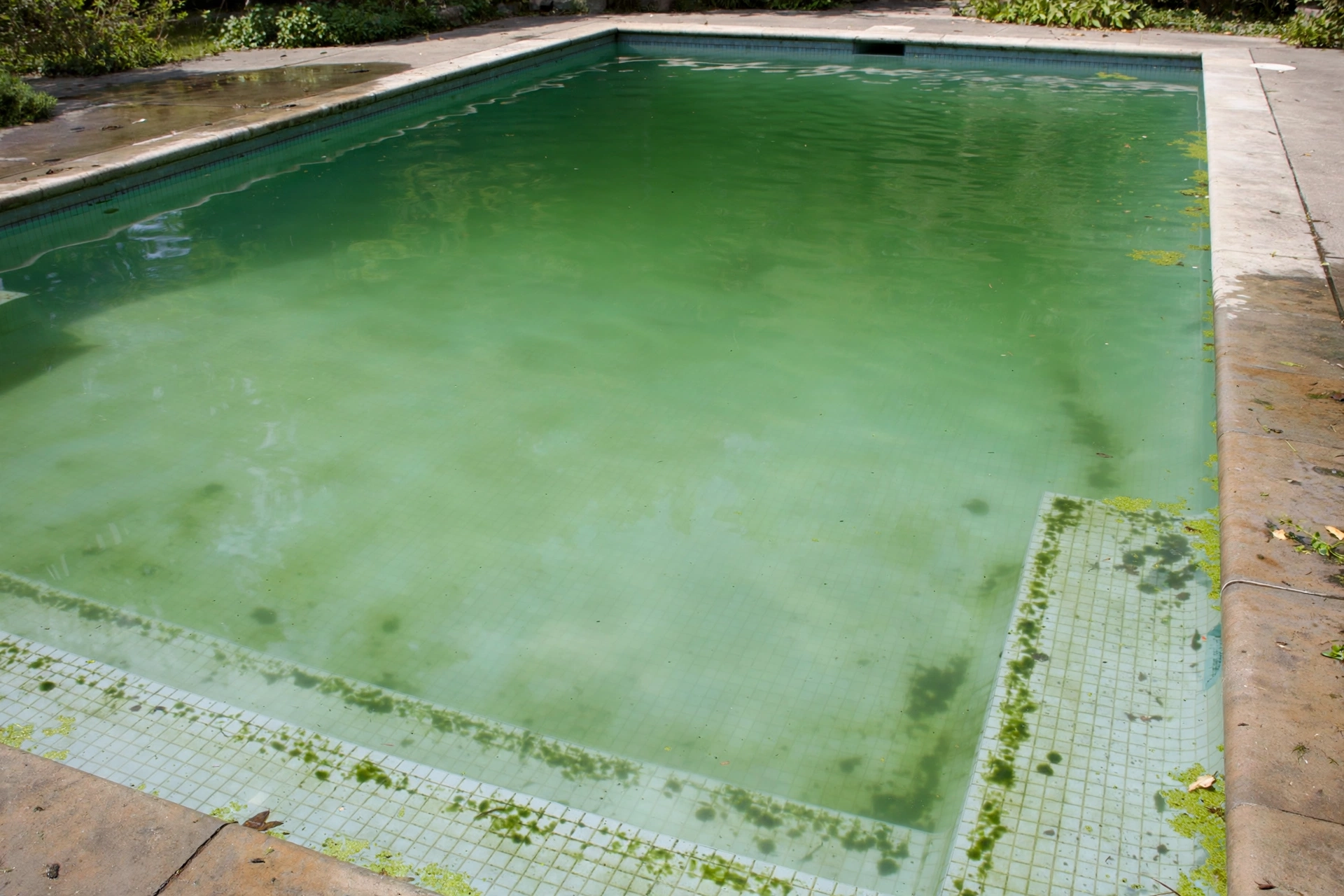
Days 1–2: test 2–3 times a day, topping back up to shock level every time. Brush every wall, step, and corner daily — the brush breaks the algae's protective biofilm so chlorine can reach it. Run the pump 24/7. The water shifts from green to a cloudy gray-green. That's dead algae: progress, not failure.
Days 3–5: the water goes milky. Keep holding the level — the filter is catching corpses now. Backwash sand or DE (or hose the cartridges) whenever pressure climbs ~25% over baseline; a choked filter slows everything down.
Days 5–7: the water turns clear, often seemingly all at once. Do not celebrate yet. Clear water is one of three pass conditions, and it's the least trustworthy one.
Done when: all three conditions below are true at the same time. Only then do you let chlorine drift back down to normal.
The 3 pass conditions — and life after green
You're finished only when all three hold: the water is clear, overnight free-chlorine loss is 1 ppm or less, and combined chlorine is 0.5 ppm or less. The overnight test is the real proof of a kill — test after sundown, test again before sunrise, adding no chlorine in between. Lost more than 1 ppm overnight? Something is still alive in there. Keep holding the level.
Stopping early is the number one reason green pools come back, and I see the pattern constantly: the water looks clear on day four, the owner relaxes, and by the weekend it's green again. 'Looks clear' is not done. The overnight test is done.
A word on algaecide, since someone will suggest it: it's prevention, not cure. During a SLAM it adds nothing — chlorine at shock level out-kills any algaecide on the shelf. Worse, copper-based algaecides add copper to your water, which can turn the pool green-teal on its own later and stain plaster (see copper stains). Save algaecide — the polyquat kind, never copper — for maintenance after the water is clear, if you use it at all.
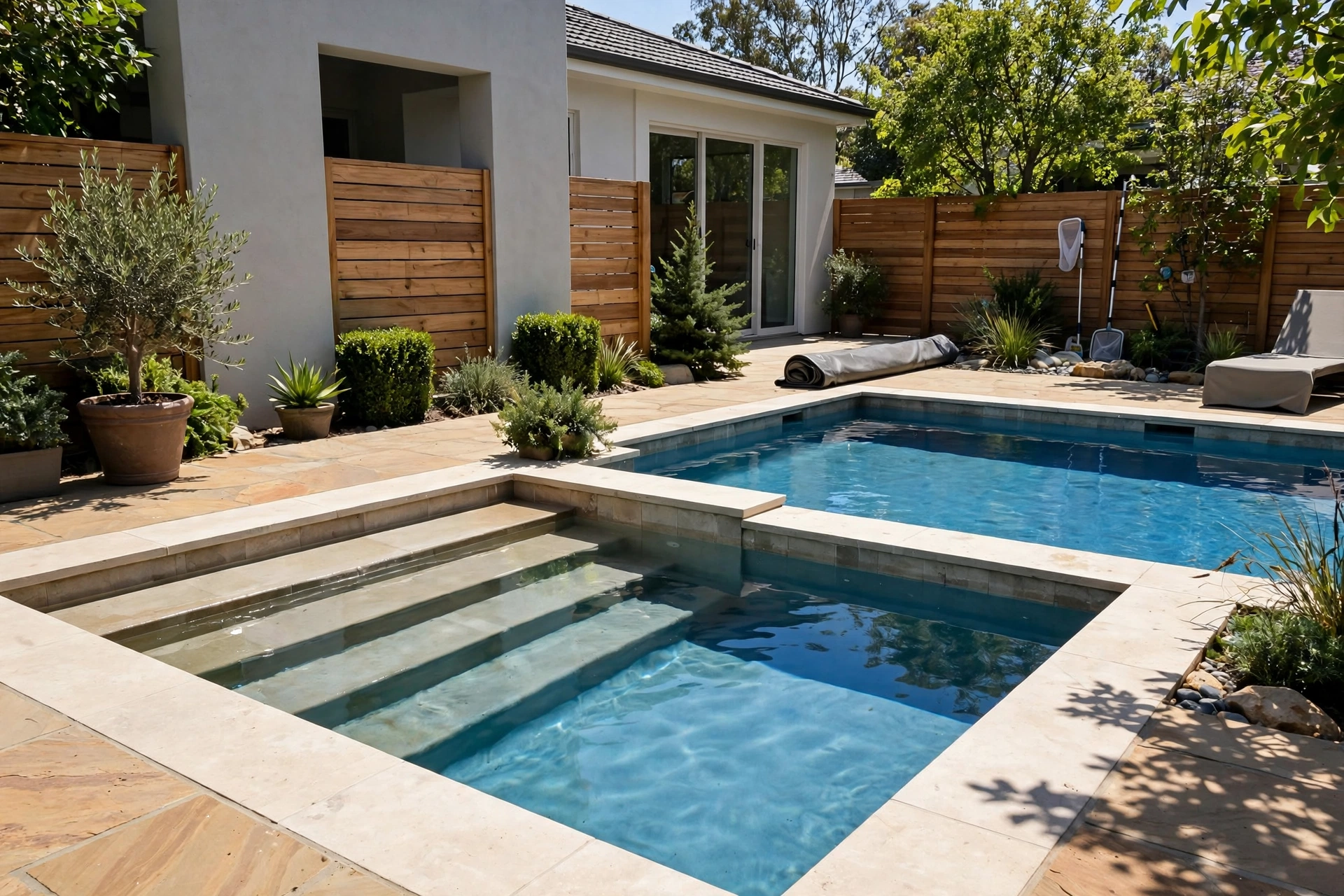
Once you're clear, the goal is never doing this again: keep free chlorine at a minimum of about 7.5% of your CYA at all times, and algae physically cannot get started. A green pool is almost always the receipt for chlorine that hit zero — after rain, heavy swimming, or a hot spell. Test after storms, keep the chlorine dose calculator bookmarked, and this stays a story you tell, not a season you repeat.
What the weekly routine looks like afterward: test free chlorine and pH two or three times a week, dose to stay above that 7.5%-of-CYA floor, brush the walls weekly even when the water looks perfect, and empty the skimmer baskets before they choke flow. After heavy rain or a big swim day, test and re-chlorinate the same evening — that's the moment most green pools are born, and catching it then costs you a cup of chlorine instead of a week of SLAM.
SLAM not working? The usual culprits
If you've held shock level for several days and the water isn't improving, something specific is wrong — the method itself rarely fails when executed fully. Run through these culprits before you change strategy.
The first suspect is always the CYA number. If you measured it with a strip, or guessed, your shock level is probably wrong — and too low just feeds the algae an expensive snack. CYA over 90 needs a dilution test to read at all; many people discover their 'CYA 60' is actually 120, which means their shock level was half of what it needed to be.
The second suspect is hiding algae. It shelters behind pool lights, inside ladder rails, under skimmer weirs, and in any niche the brush misses. Pull the light, take the ladder out and scrub inside the rails, brush behind every fitting. I've seen SLAMs stall for a week over a single dirty ladder rail.
Two more honest notes. If the algae is yellow and dust-like rather than green — brushing it makes a yellow cloud — that's likely mustard algae, and it needs a higher shock level: around 60% of CYA instead of 40%. And phosphate remover won't fix an active bloom; phosphates are algae food, but removing the food doesn't kill what's already eating. Finish the SLAM, then worry about phosphates if you want to.
- Shock level ≈ 40% of CYA (CYA 30 → ~12 ppm FC; CYA 50 → ~20 ppm FC; CYA 80 → ~32 ppm FC).
- Minimum FC to prevent algae ≈ 7.5% of CYA — never let it sit below that line.
- Done = clear water + overnight loss ≤ 1.0 ppm FC + CC ≤ 0.5 ppm. All three, no exceptions.
- Typical SLAM: 3–7 days for a green pool, longer for a true swamp.
- 12.5% liquid chlorine: ~10 fl oz per 10,000 gallons raises FC about 1 ppm — the workhorse of every SLAM.