Saltwater Pools, Explained: The Complete Owner Guide
A salt pool is a chlorine pool with a built-in chlorine factory. Dissolved salt (3000–3500 ppm) flows through the cell, electrolysis turns it into chlorine, and that chlorine sanitizes exactly like the liquid you would pour in — then reverts to salt and the cycle repeats. The quirks that catch new owners: salt pools want higher CYA (70–80 ppm), their pH climbs relentlessly, and the cell itself wears out every 3–7 years. Know those three things and the rest is routine.
Picture your first month with a salt pool. The water feels softer, nobody is complaining about red eyes, and you have not touched a chlorine jug in weeks. Then you test and the pH is 8.2, there is a white crust forming on the cell, and a warning light is blinking that you do not understand. Every salt pool owner I know has lived some version of this month — including the part where they wonder if the system is broken. It is not. You just had not been told the quirks yet.
So this page is the briefing I wish came in the box: how the system actually works, where your numbers should sit (they are different from chlorine pools), what breaks, and how to fix it without calling anyone. Still deciding between systems? Read saltwater vs chlorine first, then come back.
The mental model that makes everything click: your salt system is a chlorine factory with a dial on it. Testing, balancing, and shocking all work exactly like a regular chlorine pool. Once that lands, the rest is details.
How the cell actually works
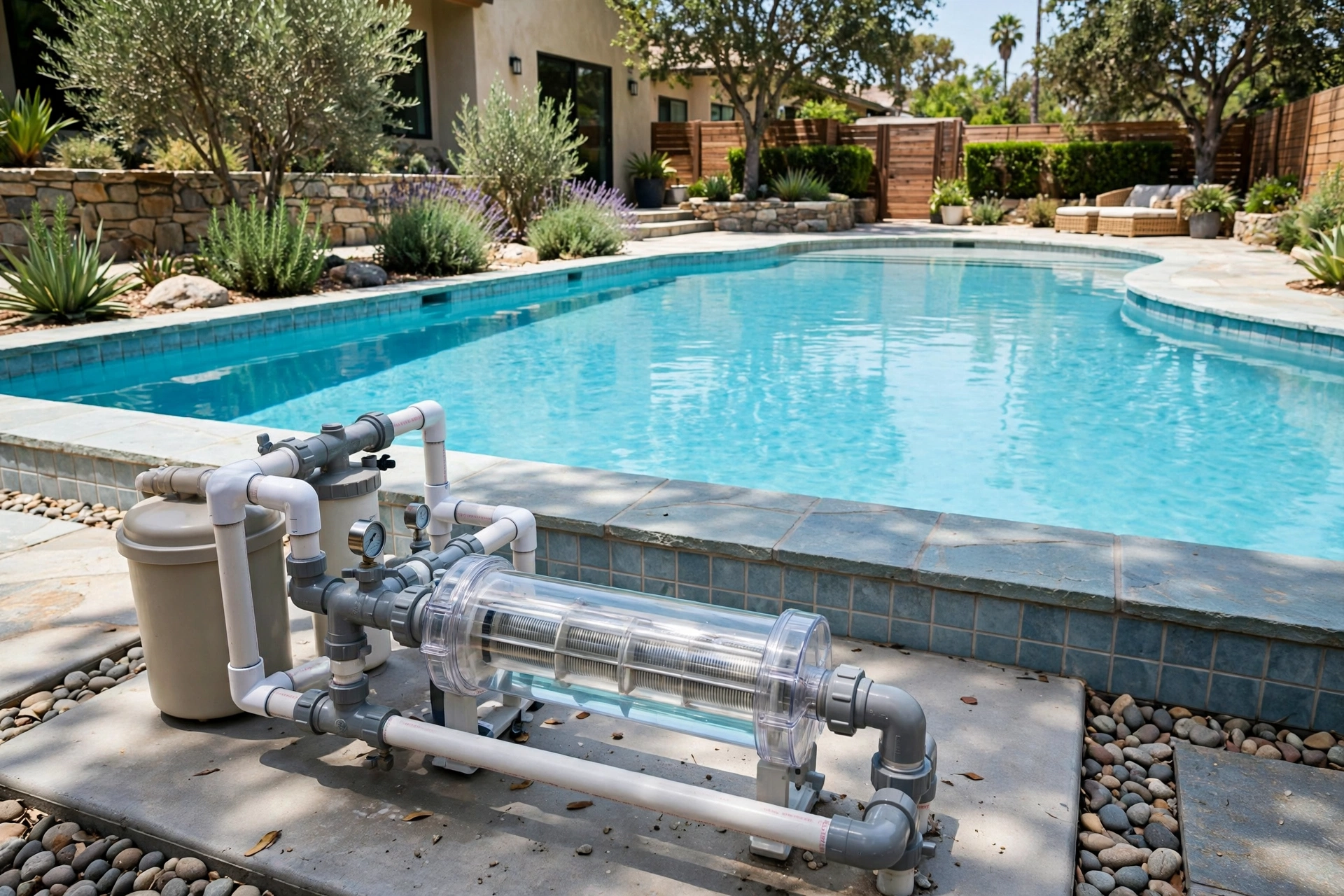
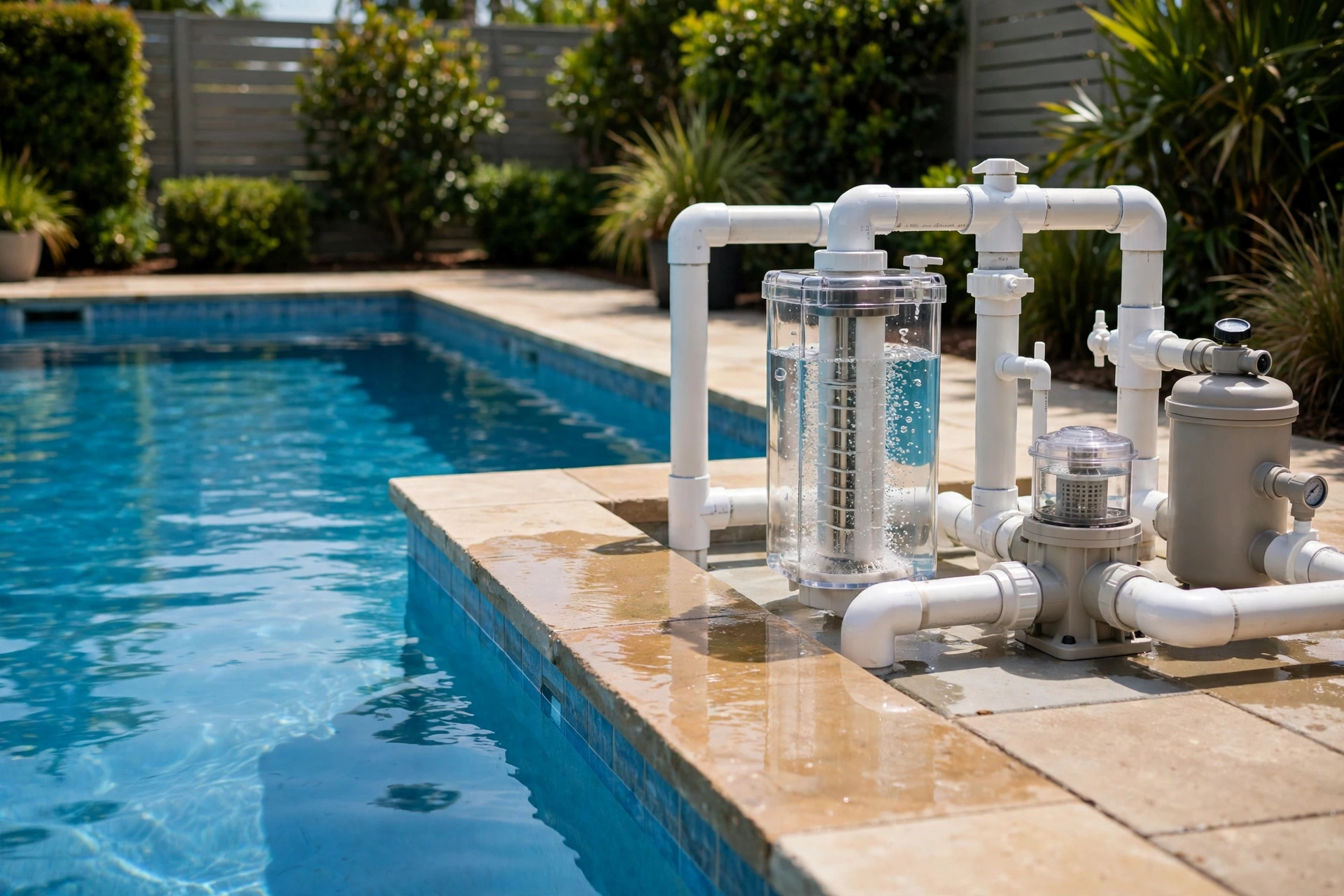
Water carrying roughly 3200 ppm of salt flows through the cell, where electrolysis splits the dissolved salt into chlorine (sodium hypochlorite) plus hydrogen gas. That chlorine sanitizes exactly like poured liquid chlorine — then it reverts back to salt, and the cycle repeats. Salt behaves more like a catalyst than a consumable: it only leaves your pool through splash-out, backwashing, and overflow from heavy rain.
The percentage dial on your control box sets how hard the cell works. And the detail new owners miss most: the cell only produces chlorine while the pump is running. No pump, no chlorine. A salt pool on a 4-hour pump schedule in July is essentially an unchlorinated pool wearing a costume — which is why pump runtime matters far more than the manual makes it sound.
One more thing worth knowing before we move on: the hydrogen gas bubbling off the plates aerates the water, and aeration pushes pH upward. That single side effect explains about half of everything salt pool owners complain about. It also explains why cell sizing matters — an undersized cell has to run at 100% all summer, which means maximum aeration and maximum pH climb, while a properly sized cell loafs along at 40–60% and gives you a much easier life.
When buying a cell, size up slightly rather than matching your gallons exactly — a cell rated for a bigger pool than yours runs at a lower percentage all season, which means less aeration, a gentler pH climb, and a longer cell life. An undersized cell screaming at 100% from June to August is the most expensive way to chlorinate a pool.
Your targets are different — write these down
Salt pools run different numbers than chlorine pools, and most of the confusion I see comes from applying chlorine-pool targets to salt water. The big one is CYA: because your chlorine trickles out slowly all day instead of arriving in one big daily dose, it needs heavier UV protection to survive — so salt pools want CYA at 70–80 ppm instead of 30–50.
Want the reasoning behind each number? The full target chart is here.
Salt: 3000–3500 ppm — but follow your cell manufacturer's manual; brands differ a bit.
CYA: 70–80 ppm. This is the number people get wrong most.
Free chlorine: 4–6 ppm — higher than chlorine pools, because it is measured against higher CYA.
Total alkalinity: 60–80 ppm — deliberately lower than usual; it slows the pH climb.
pH: 7.4–7.6 — a range you will actively defend, not just visit.
Calcium hardness: 200–400 ppm, same as always.
The pH climb: the thing nobody warns you about
Every salt pool on earth fights a slow, permanent pH climb. It is physics, not a defect: hydrogen gas aerating off the cell plates drives pH up, day after day. If you do nothing, pH parks itself around 8.2 and scale starts forming on everything — the cell, the heater, the tile line.
The standard defense has three parts: keep total alkalinity on the low side (60–80 ppm) so there is less upward pressure, add muriatic acid on a weekly rhythm using the acid routine, and treat that acid addition as maintenance — like mowing the lawn — not as an emergency.
I will be honest about what this costs you: not money, but a habit. The weekly pH check is the real ongoing price of saltwater. Skip it for a month and you will learn the lesson the way nearly everyone does — staring at scale you now have to remove. Consider yourself warned early. If you want the chemistry behind it, here is why salt pools push pH up.
When something looks wrong: the troubleshooting table
Salt systems fail in predictable ways. Before you call anyone, find your symptom below — most of these are a cleaning or a settings change, not a repair bill.
If none of that matches, the deep dives live here: generator not working and cloudy salt pool.
| What you see | Most likely cause | What to do |
|---|---|---|
| 'Low salt' warning, but your test says salt is fine | Scaled or aging cell confusing the sensor | Clean the cell per your manual; verify salt with an independent test strip or meter |
| Chlorine reads zero even though the cell is on | Output percentage too low for the demand, or pump runs too few hours | Raise the output percentage, extend pump runtime, and confirm CYA is 70–80 ppm |
| pH climbs back up within days of adding acid | Normal salt-pool behavior, usually with TA too high | Lower TA to 60–80 ppm, then keep up the weekly acid habit |
| White flakes drifting in the water | Calcium scale flaking off the cell plates | Clean the cell; keep pH and TA in range so scale stops forming |
| 'Check cell' or 'clean cell' light is on | Scale buildup on the plates | Acid-wash the cell in diluted muriatic acid exactly as your manual describes — never scrape the plates |
| Salt reading jumps around day to day | Cold water skews the sensor, or the cell is near end of life | Test salt independently; if the cell is 5+ years old, have it evaluated |
| Corrosion on ladders, rails, or heater parts | Salt water plus pH drifting low attacks metal | Hold pH at 7.4–7.6, rinse metal fixtures, and ask your builder about a sacrificial zinc anode |
Your first year, season by season
Salt pools have a rhythm. Learn it once and the years after are autopilot.
Dialing in the output percentage takes about two weeks of testing: start in the middle, test FC every few days, and nudge up or down until FC holds steady at 4–6 ppm. Write the winning percentage on the equipment pad — it will change with the seasons, but you will always have a starting point.
The full calendar version of this lives at the salt pool maintenance schedule.
Spring startup: test everything before you trust the dial — salt, CYA, TA, CH, pH. Top up salt first (use the salt calculator), then rebalance. Inspect the cell for winter scale before it runs its first full week.
Summer: weekly FC and pH tests; nudge the output dial with bather load and heat. This is when the pH habit earns its keep.
After heavy rain or backwashing: retest salt — dilution is the main way salt leaves the pool. Top up before the 'low salt' light tells you.
Fall: as water cools, chlorine demand drops — dial the output down instead of letting FC ride high all winter.
Winter (if you close): balance the water, then follow the winterizing steps. If you run year-round, keep the pump schedule honest — the cell only works when water flows.
Four myths worth killing
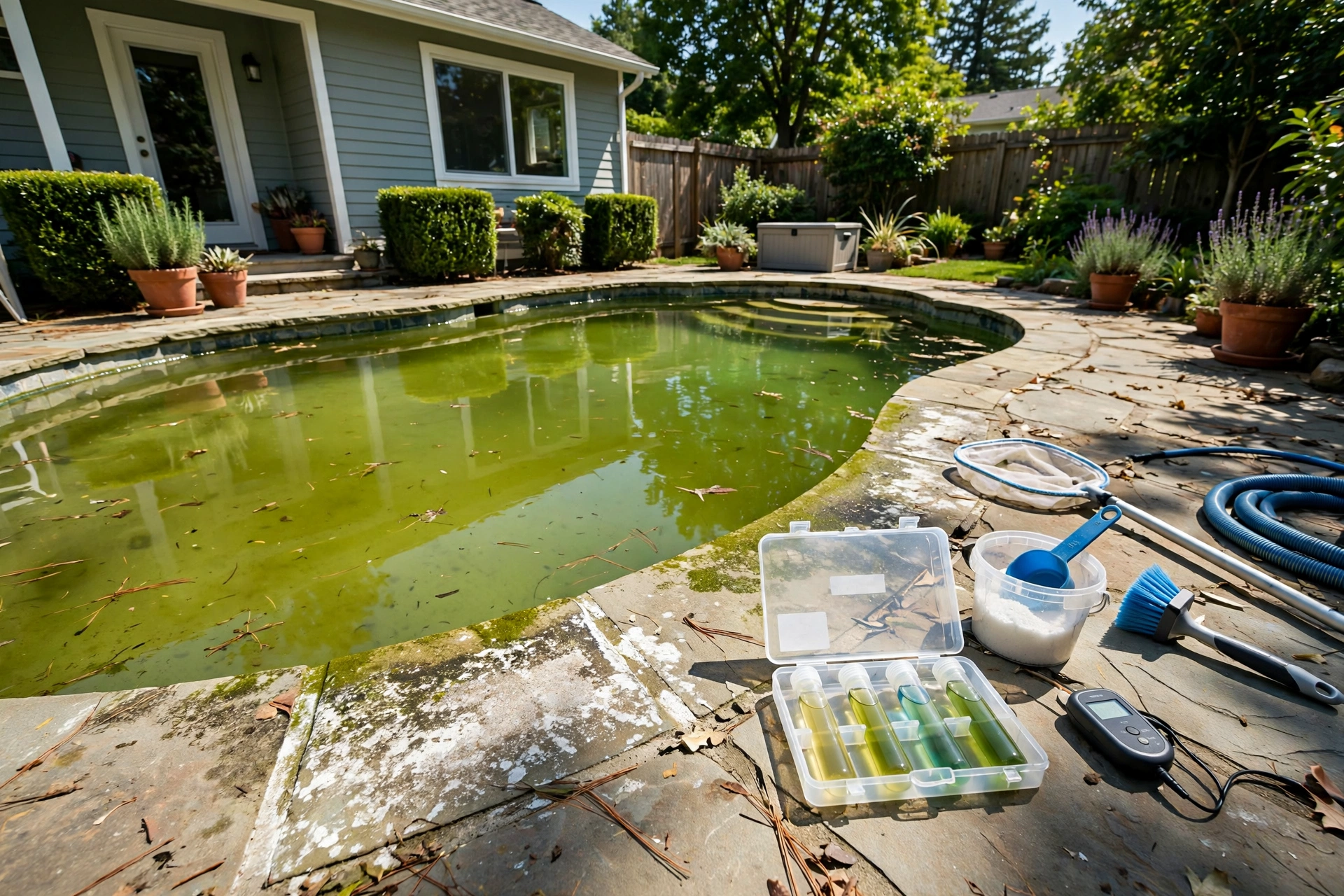
'Salt pools are chlorine-free.' No — this is the big one. A saltwater pool IS a chlorine pool; the cell manufactures chlorine from salt all day long. The sanitizer in your water is chlorine, full stop. What you skip is buying, hauling, and pouring it.
'Salt pools never get algae.' They absolutely can. If FC drops too low for your CYA level, algae does not care how the chlorine got there. Salt prevents nothing on its own.
'You never have to shock a salt pool.' Mostly true in routine weeks, false after storms, heavy bather loads, or an algae bloom. When you do need it, shocking a salt pool works like any other pool — and yes, you can do it without hurting the cell.
'Salt water ruins everything.' Salt is harder on some natural stone, cheap metal fixtures, and heaters — that is real. But at 3000–3500 ppm (roughly a tenth of seawater), with pH held in range, most modern equipment handles it fine. The damage stories almost always trace back to neglected pH, not the salt itself.
- Salt: 3000–3500 ppm (per your cell manual).
- CYA: 70–80 ppm. FC: 4–6 ppm.
- TA: 60–80 ppm. pH: 7.4–7.6.
- Cell life: roughly 3–7 years (~10,000 hours); inspect monthly.