What Is Pool Shock? (And How to Shock a Pool Right)
Shocking a pool means raising free chlorine to a high level on purpose — to kill algae, bacteria, and the chloramines that make pools smell. It is a process, not a product: "shock" is what you do, not what you buy. The right way: pick liquid chlorine or cal-hypo, dose to shock level for your CYA, and hold it there.
Walk into any pool store and "shock" sounds like a product — a bag, a brand, a weekly ritual. Here is the honest version I wish someone had given me at the start: shock is a verb, not a noun. It means dosing chlorine high enough, on purpose, to burn through everything chlorine normally handles slowly.
Once that clicks, most shock confusion disappears. The bag matters less than the dose, the dose depends on your CYA, and one big dose that fades by morning does almost nothing. Let me explain what is actually happening in your water.
What "shock" actually means
Shocking = raising free chlorine to "shock level" — roughly 40% of your CYA — and keeping it there until the job is done. At that concentration, chlorine oxidizes chloramines (the used-up chlorine compounds behind the strong "pool smell"), kills algae, and wipes out bacteria far faster than maintenance levels can.
That is the entire concept. Everything else — the bags, the brands, the "shock weekly" advice — is packaging around this one idea. If your CYA is 40, shock level is about 16 ppm. If your CYA is 80, it is about 32 ppm. Same word, very different dose — which is why understanding CYA comes before understanding shock.
What shock is NOT
Shock is not a special chemical. The bags labeled "shock" are usually just cal-hypo or dichlor in a one-pound bag with a higher price per pound. There is nothing in them that liquid chlorine from the jug cannot do — often better, because liquid adds no calcium and no CYA.
And shock is not automatically weekly maintenance. Plenty of pools never need scheduled shocking. You shock when something calls for it: visible algae, chloramines that will not clear, or after heavy use or contamination. A pool with steady chlorine and no problems does not need a weekly shock any more than a healthy person needs weekly medicine.
How to shock a pool correctly
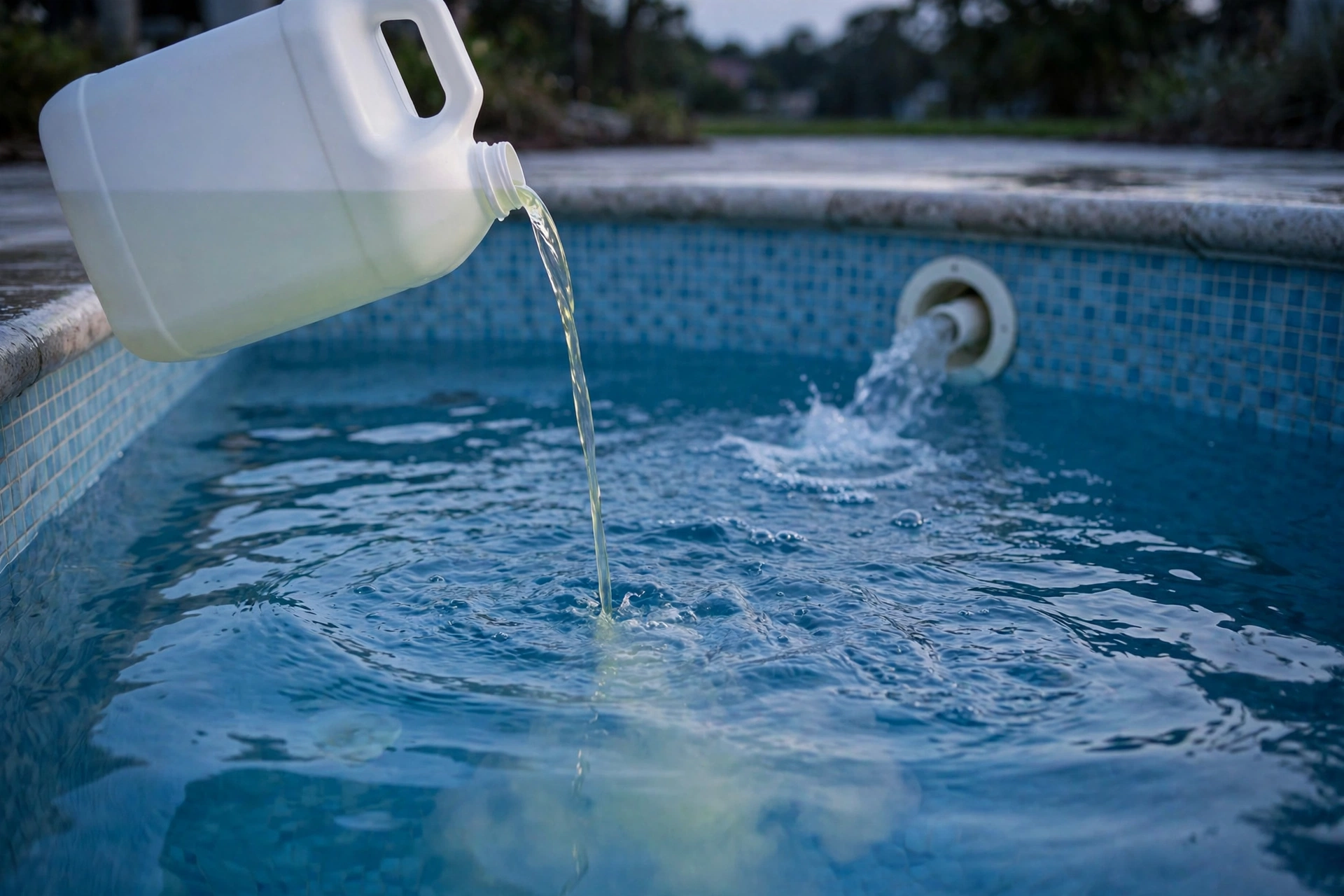
Evening is the time — sunlight burns off high chlorine fast, so dosing at dusk gives the chlorine a full night to work. Calculate your dose with the shock calculator (gallons + CYA + current FC), pour slowly in front of a return jet with the pump running, and brush the walls so nothing hides from it.
Then the part everyone skips: hold it there. Test in the morning and top back up to shock level. One dose that drifts to zero overnight just annoyed the algae. For a real cleanup, read the SLAM method — it is shocking done with discipline, and it is how green pools actually get fixed.
Which shock should you use?
My default: liquid chlorine (10–12.5%). It adds nothing but chlorine and a little salt — no calcium, no CYA, no surprises. Cal-hypo is fine if your calcium is low, but it adds calcium every dose. Dichlor adds CYA fast, which is exactly what you do not want when fighting algae. Read the full shock comparison before you buy the bag.
Whatever you choose, dose by math, not by bag. "One bag per 10,000 gallons" ignores your CYA, your current FC, and your pool size — three things that change the right dose by 2–3x. The calculator exists so you stop guessing.
- Shock level ≈ 40% of CYA (CYA 40 → ~16 ppm; CYA 80 → ~32 ppm).
- Mustard algae shock ≈ 60% of CYA.
- Shock in the evening — UV burns off high FC fast during the day.