How to Lower Alkalinity in a Pool: The Acid + Aeration Method
Here’s the thing no bottle will tell you: no chemical lowers TA by itself. The method is acid plus air. Add muriatic acid to bring pH down to about 7.0–7.2 — that drags TA down with it. Then aerate (fountains on, jets pointed up) to bring pH back up without raising TA. Repeat the cycle until TA reads 80–120 ppm.
This is the procedure pool owners search for most and find explained worst. There’s no "alkalinity decreaser" on the shelf — lowering TA is a two-step dance with acid and air. Once you understand why, it’s straightforward.
Pool chemical dose calculator
Estimate from standard pool-industry dosing ratios. Add two-thirds, retest after circulation, then top up. Never mix chlorine products together. Your product label has the final say.
Why it takes two steps
Muriatic acid lowers both pH and TA — there is no acid that targets TA alone. So step one deliberately drives pH down to ~7.0–7.2, which drags TA down with it. Step two is aeration: moving water drives off CO2, which lifts pH with zero effect on TA. Net result of one cycle: TA lower, pH restored.
Each cycle usually drops TA 10–20 ppm. Going from 200 to 100 takes several cycles over several days. Patience is the active ingredient — there’s no shortcutting this one.
The cycle, step by step
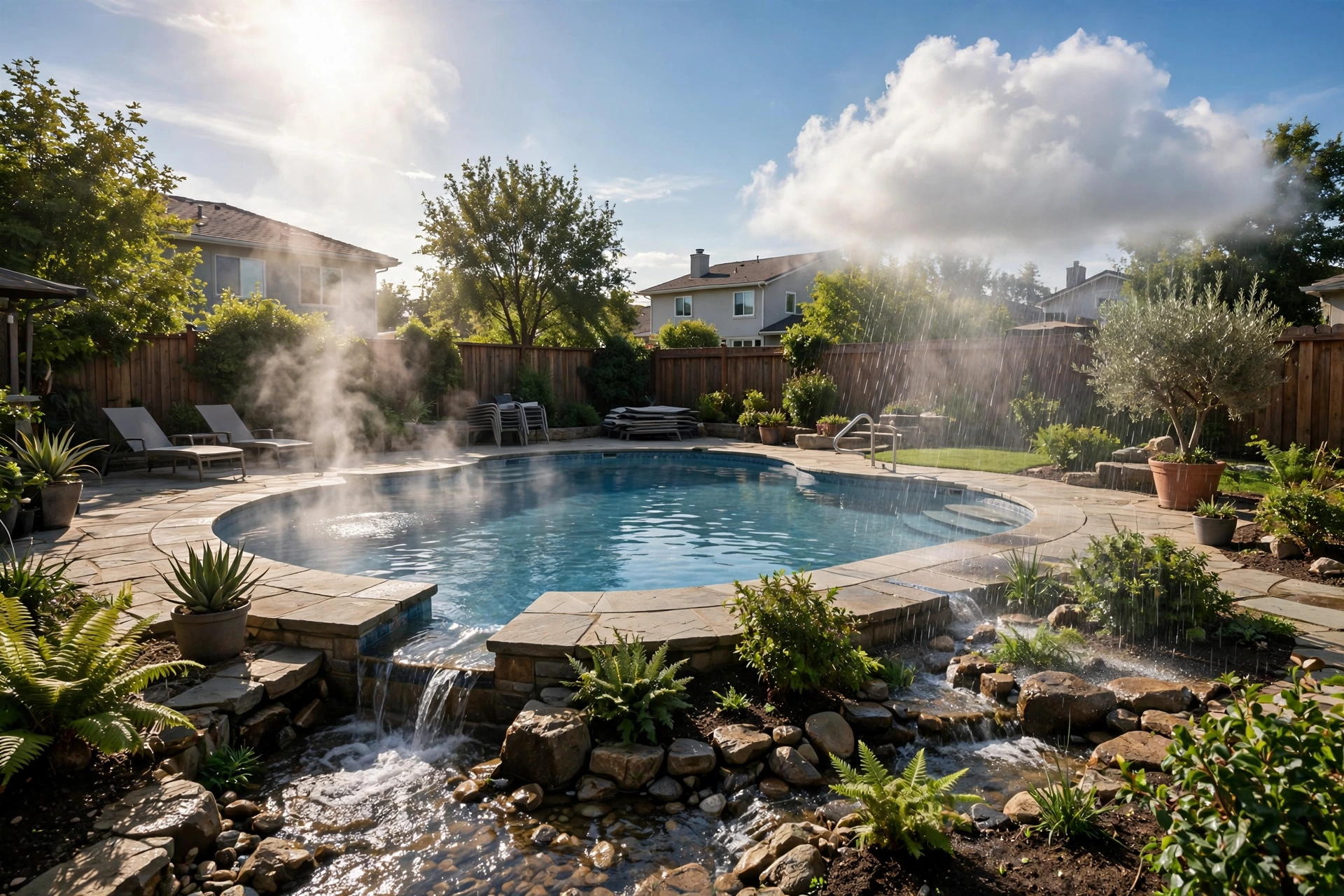
1) Test TA and pH. 2) Add enough acid (per the acid calculator) to reach pH ~7.0–7.2. 3) Aerate hard — waterfall on, fountains on, return jets pointed up and breaking the surface. 4) When pH climbs back to ~7.6–7.8, retest TA. 5) Repeat until TA lands at 80–120.
Don’t try to do it in one giant acid dose. Sitting under pH 7.0 for extended periods is corrosive to equipment. Small cycles, retesting each time — boring, but it works.
When to bother
Lower TA when pH constantly drifts up and won’t stay down, or when TA tests over ~150. But don’t chase TA from 130 down to 100 if your pH is stable — stable beats textbook every time. Running a salt pool? Target TA 60–80, since you’ve got constant aeration anyway.
- Acid to pH ~7.0–7.2 (drops TA too).
- Aerate: pH rises, TA stays.
- Each cycle: TA down ~10–20 ppm.
- Target: 80–120 ppm (60–80 for saltwater).