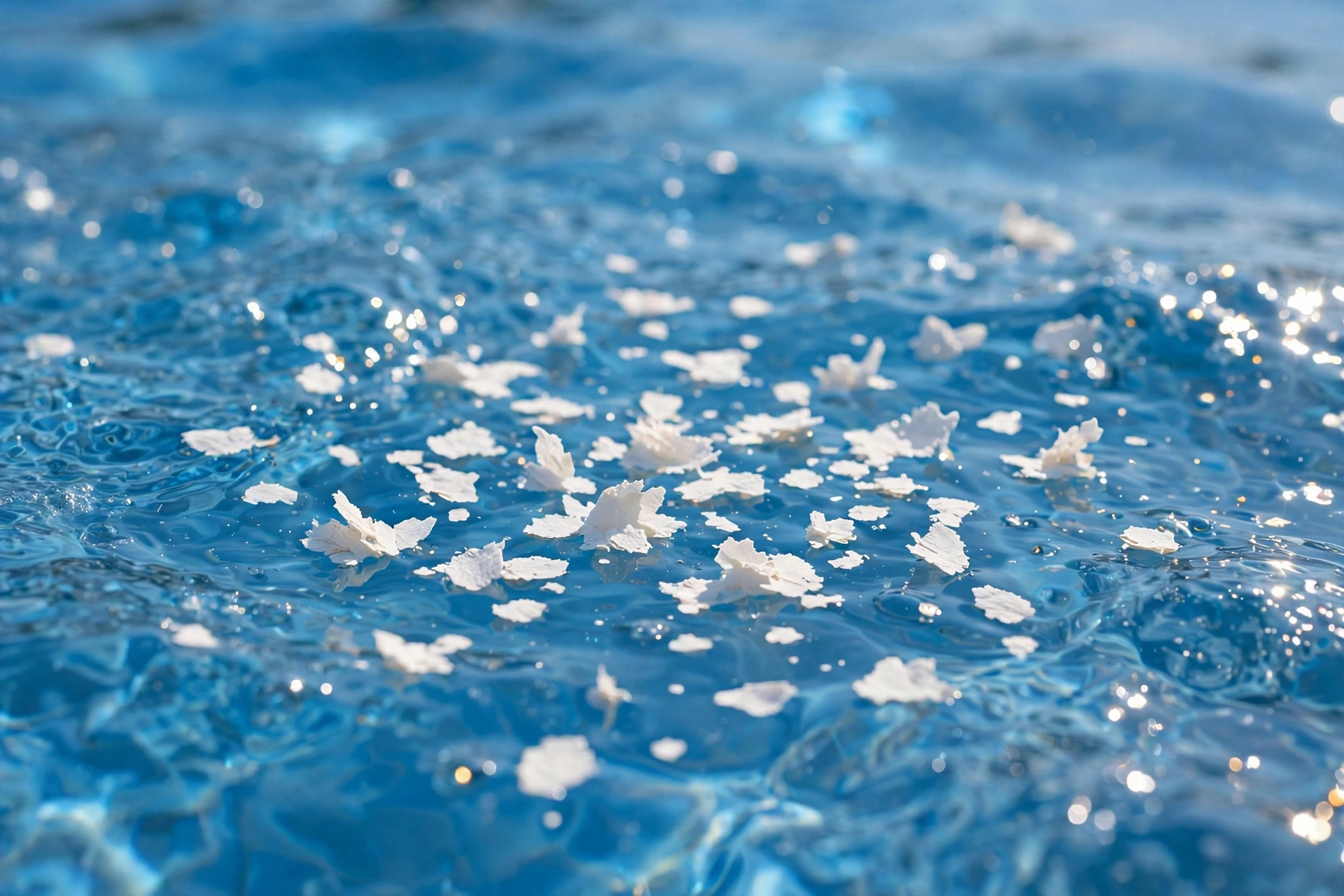
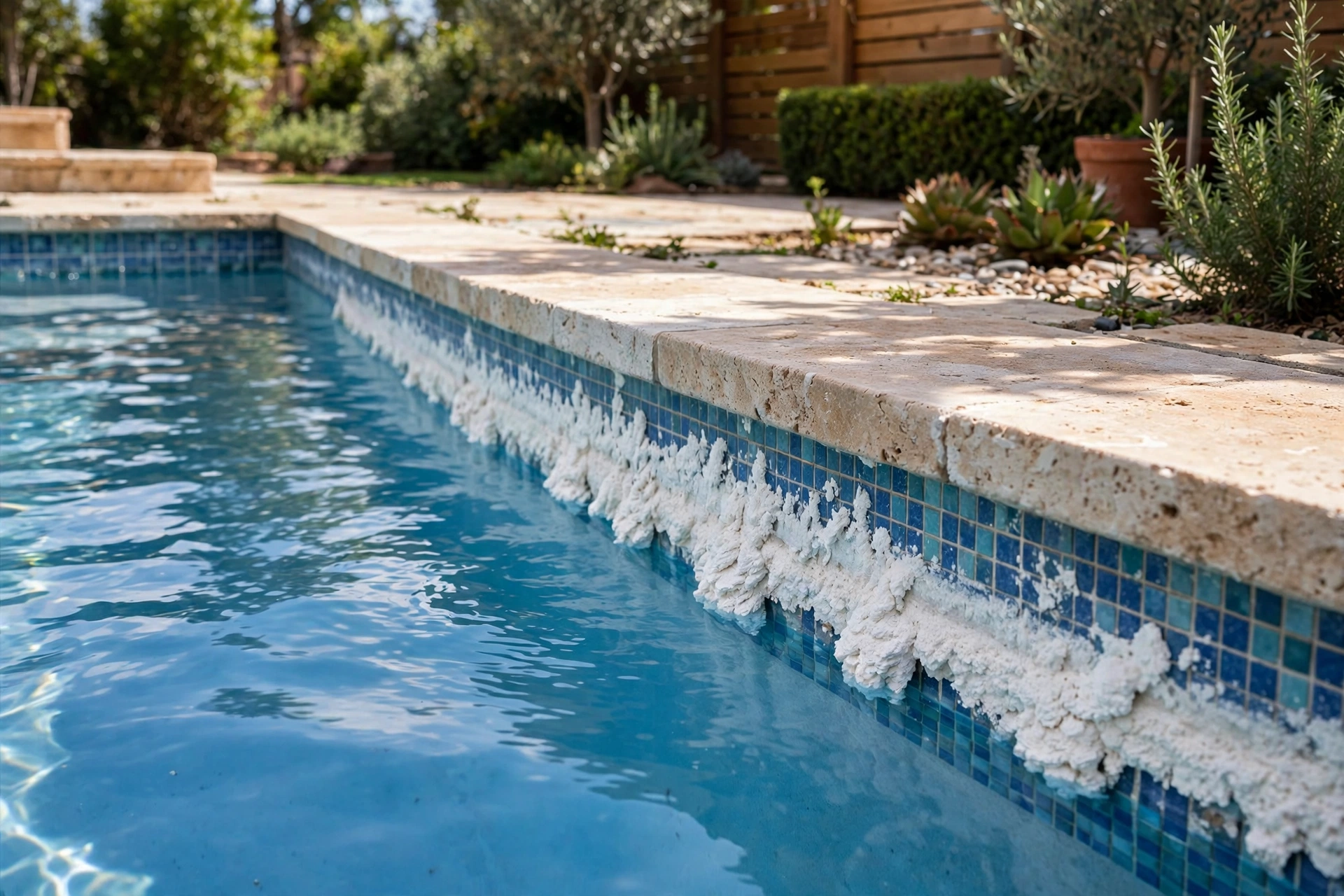
White flakes are almost always calcium carbonate scale — your water got too scale-forming (high pH, high calcium, or both) and the excess is flaking off surfaces, the salt cell, or the heater. Confirm with pH and CH tests: pH 8+ with CH 400+ is your answer. Bring pH down into range, clean the salt cell, and if calcium is very high, plan a partial drain.
White flakes drifting like snow, gritty bits collecting in the skimmer, a white crust at the waterline — it is all the same story: calcium that used to be dissolved and is not anymore. The water turned scale-forming, and now the excess is coming out wherever it pleases. Annoying, but very fixable.
Here is a neat little test: drop some flakes in a cup with a splash of muriatic acid — outdoors, and carefully. If they fizz and dissolve, that is calcium carbonate, case closed. (Gloves and eye protection for this, please — acid is acid even in a cup.) Then test pH and CH to find the cause. Salt pool owners, check the cell first: a scaling cell sheds flakes nonstop, and it means your pH has been running high.
The fix
Lower pH to 7.2–7.4 with acid and hold it there — new scale stops forming, and light scale slowly redissolves on its own. Clean the salt cell. Brush the surfaces to knock loose deposits toward the filter. For heavy crust on tile, a diluted acid wash (follow your product label's directions exactly, gloves and eye protection on) or pumice stone; for CH above ~500, a partial drain and refill.
And the part people skip: prevention. It is the same discipline as everything else in pool care — pH in range, CH in range (see the calcium guide), and for salt pools, TA at 60–80 to slow the pH climb that drives all this scaling.
Safety warning. Never mix different chlorine products together, and never mix chlorine with acid. Wear gloves and eye protection, add chemicals to water (never water to chemicals), and follow the exact instructions on your product label — the label overrides any calculator. Store chemicals dry, separate, and away from kids and pets.
Common questions
Are white flakes in pool water harmful?
Not to swimmers — it is just calcium carbonate, harmless stuff. But it is your water waving a flag: scale-forming water shortens the life of your equipment and salt cell, so do not ignore the message.
Why does my salt pool have white flakes?
Your cell is scaling, which means pH has been running high. Clean the cell, bring pH down, and keep TA at 60–80 to slow the climb.
How do I get rid of white flakes in my pool?
If it's calcium scale: get pH and CH under control, brush it off, and stop adding calcium (no more cal-hypo). For heavy scale on surfaces, diluted acid wash or a pumice stone. If it's white water mold, that's a different fight — sustained chlorine and serious brushing.
Why are there white particles floating in my pool?
Two usual suspects: calcium precipitating out (high CH plus high pH, often right after cal-hypo shock) or white water mold (tissue-like, in low-circulation spots). Calcium feels gritty; mold feels slimy. Test your water and you'll know which.
Why do I get white flakes right after shocking?
That's calcium dropping out of solution — cal-hypo shock adds calcium, and if your CH was already high or pH drifted up, it precipitates as white flakes. Switch to liquid chlorine for shocking and the flakes stop.
Will shock get rid of biofilm?
Not by itself. Biofilm (including white water mold) shrugs off normal chlorine levels — you need sustained shock-level FC plus aggressive brushing to break the colonies open. Shock without brushing is just expensive water.
Last reviewed: September 29, 2026. Dosing figures are estimates from standard pool-industry ratios — always confirm against your product label and a reliable test kit.