If TA is also low, reach for soda ash (washing soda) and dose it by weight. If TA is already fine or high, aerate instead — run the fountains or waterfall, or point your return jets up so they break the surface. That drives off CO2 and lifts pH without touching TA. Whatever you do, don’t throw soda ash at a pool whose TA is already high — you’ll start a seesaw you’ll regret.
Low pH — under 7.2 — is acidic enough to sting eyes, chew on equipment, and etch plaster over time. Raising it is easy. But the right method depends on your TA, and picking wrong just trades one problem for another.
Rough estimate: about 12 oz per 10,000 gal per 0.2 pH rise. pH response varies with alkalinity — add half and retest.
Estimate from standard pool-industry dosing ratios. Add two-thirds, retest after circulation, then top up. Never mix chlorine products together. Your product label has the final say.
Check TA before choosing
TA low (under 60) and pH low: use soda ash — it raises both, which is exactly what you need. TA fine (80–120) and pH low: aerate. Run the fountains, turn on the waterfall, or point the jets up. The moving water drives off CO2 and lifts pH with zero chemicals and zero TA change. It’s the elegant answer, and most guides bury it.
TA high with pH low is weird — retest both before you do anything, because something’s off. Usually a testing error.
Using soda ash
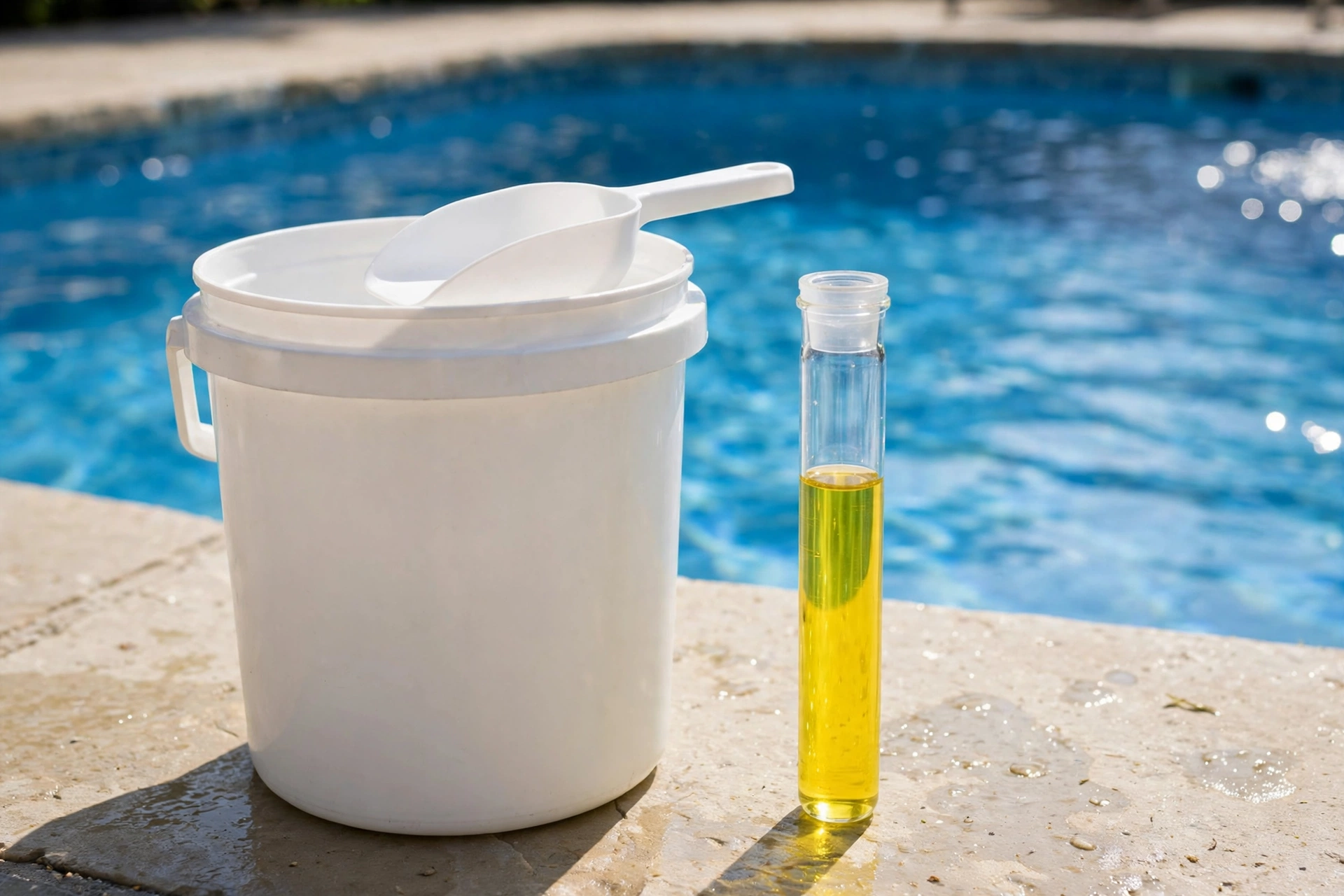
Dose it with the calculator, dissolve it in a bucket of pool water, and distribute it with the pump running. Add half, retest in a few hours. Soda ash moves pH hard — overshooting past 8.0 is the classic mistake, and then you’re adding acid to fix the fixer. Half doses, every time.
Safety warning. Never mix different chlorine products together, and never mix chlorine with acid. Wear gloves and eye protection, add chemicals to water (never water to chemicals), and follow the exact instructions on your product label — the label overrides any calculator. Store chemicals dry, separate, and away from kids and pets.
Common questions
Can I use baking soda to raise pH?
Barely. Baking soda mostly raises TA and only nudges pH. For a real pH lift, use soda ash — or aeration if your TA is already where it should be.
How long does aeration take to raise pH?
Hours to a day, depending on how much water you’re moving. A waterfall running overnight can lift pH 0.2–0.4. Test before, test after.
How can I raise my pool’s pH fast?
Soda ash, dosed by weight — it’s the fastest chemical route. Aeration (fountains, waterfall) is free but takes hours. Either way, add half, retest, then top up; pH overshoots are the classic mistake here.
What happens if pool pH stays too low?
Under 7.2, water turns aggressive: stinging eyes, corroded heater elements and pump seals, and etched plaster over time. It’s also why I say fix pH before fine-tuning chlorine — extreme pH skews everything else.
Does shocking raise pool pH?
Temporarily, yes — liquid chlorine and cal-hypo both nudge pH up when added. Trichlor and dichlor do the opposite. The effect usually settles as chlorine gets used, so don’t chase pH right after a big shock dose.
Is pH increaser the same as baking soda?
No. pH increaser is soda ash (sodium carbonate) — it moves pH strongly. Baking soda (sodium bicarbonate) mostly raises alkalinity and barely moves pH. Using one for the other’s job is a common and frustrating mix-up.
Last reviewed: September 29, 2026. Dosing figures are estimates from standard pool-industry ratios — always confirm against your product label and a reliable test kit.